
Best Greyhound Betting Sites – Bet on Greyhounds in 2026
Loading...
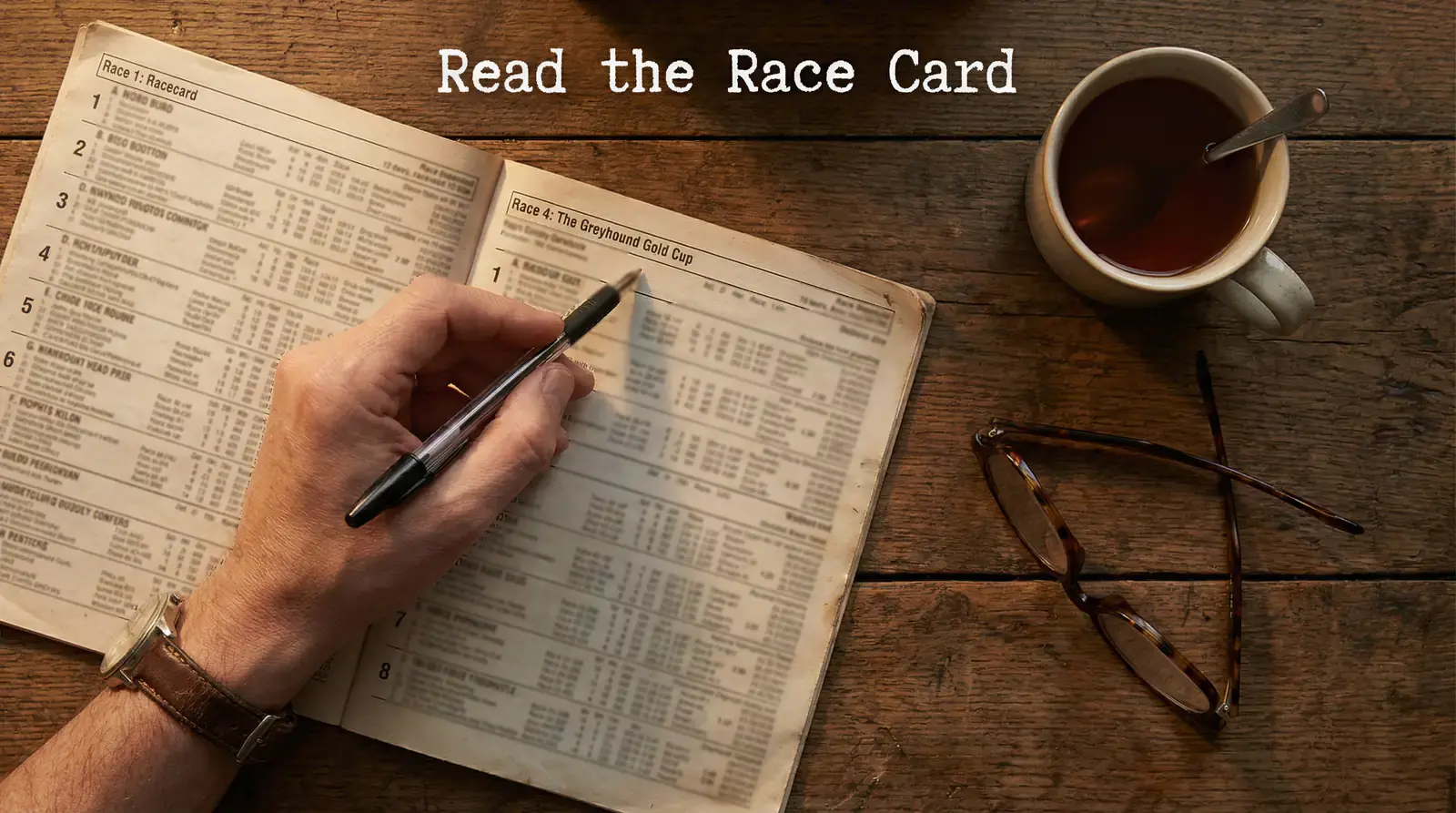
The Race Card Is a Compressed Story
Every greyhound’s last six races are on that card — if you can read them. The racecard for a GBGB greyhound meeting is a dense document. It looks, at first glance, like a wall of numbers, abbreviations, and shorthand that only makes sense to the people who already know what it means. That impression is not entirely wrong. The card is compressed. It uses codes instead of sentences. It assumes familiarity with concepts like calculated times, sectional placings, and going allowance that many casual punters have never encountered.
But the information it contains is not complex. Each element on the racecard answers a specific, practical question. What grade is the race? How fast has this dog been running? Where was it positioned at each bend? Did it encounter trouble? Has its weight changed? Is the trainer in form? The answers are all there, arranged in a standardised format that, once you understand the layout, can be read in under a minute per dog. Six dogs, six minutes, and you have a picture of the race that is sharper than anything the odds alone can give you.
This guide breaks the racecard down into its components, explains what each one tells you, and shows you how to use that information to assess a race. It is written for the bettor who has placed a few greyhound bets and wants to move from guessing to reading — from picking dogs based on names and prices to selecting them based on evidence. The racecard is the single most valuable tool available to a greyhound punter, and it costs nothing to use. All it requires is the patience to learn what the numbers mean.
The Race Header: Time, Distance, Grade
Start at the top and work down. Every race on a greyhound card begins with a header line that tells you the essential facts: the scheduled race time, the distance, the grade, and usually the prize money. These four pieces of information set the context for everything that follows.
The race time is self-explanatory — it tells you when the traps open. The distance is measured in metres and defines the type of race. At most GBGB tracks, you will see sprint distances around 260 to 280 metres (two bends), standard distances around 460 to 480 metres (four bends), and staying trips from 640 metres upward (six or more bends). The distance dictates which dogs are suited to the race and which form factors carry the most weight. Over a sprint, early pace is paramount. Over a staying trip, stamina matters more than speed.
The grade — A1, A5, D2, S3, OR — tells you the level of competition. The letter denotes the race type: “A” for standard graded races over the track’s main distance, “D” for sprint grades, “S” for staying grades, and “OR” for open races that sit outside the normal grading ladder. The number reflects the quality band within that type. A1 is the top tier of standard graded racing at the track. A7 or A8 represents the lower end. Dogs are placed in a grade based on their recent times over the relevant distance, and they move up after winning or down after consistent poor finishes.
The grade matters for betting because it tells you the quality of the opposition. A dog dropping from A3 to A4 is meeting weaker rivals — all else being equal, its chance of winning has improved. A dog rising from A5 to A4 after a win faces stiffer competition and may struggle to repeat the result. The grade is not a definitive measure of ability, but it is the starting point for every assessment. Ignoring it means ignoring the competitive context of the race.
Prize money, listed in the header, gives a secondary indication of race quality. Higher prizes attract better dogs. Open races and finals of competitions carry larger purses than routine graded races, and the class of dog competing will reflect that. For betting purposes, prize money is less directly useful than the grade, but it confirms whether you are looking at a standard weeknight card or a feature meeting with stronger-than-usual fields.
Individual Dog Information
Name, sire, dam, trainer — background data that shapes the story. Below the race header, each dog in the field gets its own block of information. This block is where the form picture begins to build, starting with the dog’s identity and basic profile before moving into the detailed race-by-race form lines.
The trap number and colour are the first things listed. Trap one wears red, two wears blue, three wears white, four wears black, five wears orange, and six wears black-and-white stripes. These colours, defined under GBGB Rule 118, are universal across all UK tracks and make it possible to identify each runner on the live broadcast without knowing the dogs by sight. When you watch a race, the jacket colours are your reference for tracking each dog’s position through the bends.
The dog’s name follows, along with its breeding (sire and dam), its date of birth or age, its sex, its colour, and the name of its trainer. Breeding is primarily useful for staying races, where stamina pedigree can help you assess a dog trying a longer distance for the first time. For standard and sprint races, breeding is background information rather than a betting factor.
The trainer’s name is more immediately useful. Trainer form — the percentage of winners a kennel has produced recently — is a real performance indicator. A kennel running hot, with winners across multiple meetings, is likely managing its dogs well. A kennel in a cold streak may be dealing with issues that affect the whole string. Tracking trainer strike rates is a practical edge, particularly at tracks where a small number of kennels supply most of the runners.
The dog’s weight and its running style designation round out the profile. Weight is recorded at the track on race night and expressed in kilograms. Running style is indicated by codes: “Rls” for a rails runner that hugs the inside, “Mid” for a middle runner, and “W” for a wide runner. These designations tell you where the dog naturally positions itself during the race, which directly interacts with the trap draw. A rails runner drawn in trap one is ideally placed. A rails runner drawn in trap six faces an immediate problem — it needs to cross the field to reach the inside line, creating potential trouble for itself and others.
Reading the Form Lines
Six lines. Six races. One decision. The heart of the racecard is the form section — a grid showing each dog’s most recent runs, typically the last six. Each line represents a single race and contains, compressed into a row of numbers and codes, almost everything you need to know about what happened: when the race took place, which track, the distance, the finishing position, the time, the sectional data, and comments describing how the dog ran. Reading these lines fluently is the skill that separates punters who bet on evidence from those who bet on hope.
Each form line reads from left to right. The date and venue come first, followed by the distance and grade. Then you see the dog’s finishing position, the time, and the margin by which it won or was beaten. After that come the sectional details — positions at each bend — and the race comments. Some racecards also include the going allowance for that meeting, the calculated time, and the dog’s weight on the night. The exact layout varies between form services, but the data is consistent.
Split Times and Calculated Times
The split time — sometimes called the sectional time — is the elapsed time from the opening of the traps to the moment the dog crosses the finishing line for the first time. In a four-bend race, the dogs pass the line once on their way round the circuit before completing the full trip and finishing. The split captures the opening phase: the break, the initial sprint, and the approach to the first bend.
This figure is the single most predictive metric on the racecard for assessing early pace. A dog with a split of 4.2 seconds at a track like Romford or Crayford is demonstrating sharp acceleration that will put it at or near the front when the field converges on the first turn. A dog with a split of 4.7 or above is likely to be in the back half of the field and exposed to crowding. The gap between a fast and a slow split translates directly into positional advantage — the dog with the quicker split has cleaner air and a better chance of running its race unimpeded.
Calculated time is the dog’s raw finishing time adjusted for the going allowance — a figure published at each meeting that quantifies how much the track surface was faster or slower than the standard baseline. The formula is simple: calculated time equals raw time minus going allowance. A positive allowance means slow going; a negative allowance means fast going. The weight-and-going section below works through the arithmetic in detail, but the principle is this: raw times are distorted by conditions, and calculated times remove that distortion.
Always compare calculated times rather than raw times when assessing dogs from different meetings. A dog whose calculated times are consistently around 29.3 over the last four runs is delivering a level of performance you can rely on, regardless of what the raw clock showed on each night. When two dogs’ raw times look similar but their calculated times diverge, the conditions were doing the work, not the dogs. The calculated column is the one that tells the truth.
Sectional Placings: Reading the Race as It Happened
Sectional placings record the dog’s position in the field at each bend. A typical four-bend race will show four numbers — the dog’s position at bends one, two, three, and four — followed by its finishing position. These numbers reconstruct the race in a way that the finishing result alone cannot.
A dog that ran 3-3-2-1 was third at the first two bends, moved to second at bend three, and took the lead at bend four before winning. That is the profile of a closer — a dog that improves its position through the race and finishes strongest. A dog that ran 1-1-1-2 led the race until the final bend and was overtaken on the run to the line. That is a frontrunner that lacked the stamina or the finishing pace to sustain its lead.
These patterns are remarkably consistent within individual dogs. A closer will close in most of its races. A frontrunner will lead in most of its races. Identifying the pattern from the form lines lets you predict how the dog will run in its next race — and more importantly, how its running style will interact with the running styles of the other five dogs in the field. A race with three confirmed frontrunners drawn in adjacent traps is likely to produce crowding at the first bend. A race with one clear pace dog and five closers is likely to see the pace dog go uncontested to the first turn.
The most revealing form lines are those where the sectional placings contradict the finishing position. A dog that was first at bend two and fourth at the finish was overtaken twice in the second half of the race — a sign of fading stamina or trouble at the later bends. A dog that was sixth at bend one and second at the finish made up significant ground, suggesting genuine ability that was masked by a slow start or early interference. These discrepancies between early position and final result are where the hidden form lies, and they are invisible to anyone who looks only at the finishing position.
Race Comments and Abbreviations
Three letters can tell you everything about a troubled run. After the positional data, each form line includes a set of abbreviated comments that describe how the dog ran — what went right, what went wrong, and what happened at key moments in the race. These comments are written by the race grader and published as part of the official result. They are the qualitative layer that sits on top of the quantitative data, and ignoring them means throwing away context that can change your entire reading of a form line.
Positive Running Comments: QAw, EP, Led
“QAw” means quick away — the dog left the traps sharply and was among the first to show on the early pace. “EP” means early pace, indicating the dog showed speed in the opening phase of the race. “Led” means the dog was in front at a specified point, often for a sustained portion of the race. These are the comments you want to see on a dog you are considering as a frontrunner or a pace angle. They confirm that the dog’s split times are translating into genuine positional advantage on the track.
“RanOn” means the dog was finishing strongly at the end of the race — gaining ground through the final straight. This is the hallmark of a closer, a dog with reserves of speed or stamina that allowed it to pick off tiring rivals in the final phase. “RlsStt” — rails to straight — indicates the dog ran the inside line and then switched to the straight for the finish, a clean and efficient racing pattern. “Ld4” or “LedRnIn” means led from bend four and ran on to win, the signature of a dog that times its challenge perfectly.
Positive comments build confidence in a form line. If a dog won its last race with comments showing “QAw, EP, Led” throughout, the performance was authoritative — the dog controlled the race from start to finish. If a dog won despite showing “Mid” or moderate positional comments, the win was harder earned and the performance may be less repeatable. The comments add texture to the bare result and help you judge whether the performance was dominant or fortunate.
Trouble Comments: SAw, Crd, Bmp, ChlRun
“SAw” — slow away — is one of the most important comments on the card. It means the dog was slow out of the traps, losing ground before the race properly began. In a sprint, a slow away is nearly always fatal. In a four-bend race, it means the dog was behind the pace going into the first turn and probably encountered interference. A dog with SAw in its recent form is either a habitual slow starter — in which case the pattern will repeat — or it had a one-off bad break that may not recur. Checking whether the comment appears consistently or just once tells you which interpretation is correct.
“Crd” means crowded — the dog was squeezed by runners on either side, typically at a bend. “Bmp” means bumped, a more direct physical contact. “CkBnd” means checked at a bend — the dog was forced to slow down because of interference ahead. These comments are excuses, and they are valid ones. A dog that finished fifth with “Crd1, Bmp2” (crowded at bend one, bumped at bend two) was beaten by circumstances rather than ability. Its finishing time and position do not reflect its true capability. If the same dog draws a cleaner trap in its next race, the trouble may not recur, and the true ability reasserts itself.
“ChlRun” — challenged and run — indicates the dog was in a close contest, racing alongside another runner through the final stages. “RnW” means ran wide, covering extra ground on the bends. Unlike crowding, running wide is often a characteristic of the dog’s running style rather than an external event. A dog that shows “RnW” repeatedly is a habitual wide runner, and the extra distance is built into its expected performance. It is not an excuse in the same way that crowding is.
The skill in reading comments is distinguishing between trouble that was imposed on the dog and trouble the dog created for itself. External interference — crowding, bumping, checking — is a reason to upgrade the dog’s form. Self-inflicted issues — running wide, missing the break through temperament rather than trap malfunction — are likely to recur. The former is a betting opportunity. The latter is a structural weakness.
Weight, Going and Adjusted Times
Two variables the casual punter ignores — and the sharp one doesn’t. A dog’s weight on race night is recorded on the card in kilograms, and changes from run to run carry information about the dog’s condition. Going allowance, published for each meeting, determines whether the track was fast, slow, or standard. Together, these data points refine your assessment beyond what times and positions alone can provide.
Weight fluctuates naturally between races. A variation of two or three tenths of a kilogram is routine and carries no particular significance. What matters is the trend. A dog that has gained half a kilogram over its last three outings may be carrying extra condition — well-fed but lacking sharpness. A dog that has lost weight consistently may be under stress or not eating well. Neither scenario is definitive, but both are signals worth noting, particularly when the weight trend aligns with other form indicators. A dog whose times are slowing and whose weight is creeping upward is showing two independent signs of declining condition. A dog running fast times at a stable weight is ticking every fitness box.
Going allowance is the adjustment that makes time comparisons meaningful. Each meeting publishes a figure — positive for slow going, negative for fast going — that reflects how much the track surface deviated from standard conditions. Applying the going allowance to a dog’s raw time produces the calculated time, which strips out the surface effect and gives you a standardised speed figure. Without this adjustment, you are comparing numbers that were produced on different surfaces and treating them as equivalent, which they are not.
A practical example: Dog A ran 29.2 last Wednesday on a fast track with a going allowance of -0.20. Calculated time: 29.40. Dog B ran 29.6 on Friday on heavy going with an allowance of +0.30. Calculated time: 29.30. On raw times, Dog A looks faster by four tenths. On calculated times, Dog B is actually the quicker performer by one tenth. That difference — the one you can only see after adjusting for conditions — is the gap between accurate form reading and misleading comparison.
Some racecards display calculated times alongside raw times. Others publish only the raw figure and the going allowance, leaving you to do the subtraction. Either way, building the habit of working with adjusted times rather than raw times eliminates an entire category of error from your form analysis. It takes a few seconds per form line and produces a significantly more accurate picture of each dog’s recent performance.
Putting It All Together: A Full Race Card Walkthrough
Let’s take a real-format card and decode every cell. Imagine you are looking at the racecard for an A4 graded race over 480 metres at a standard GBGB track. The header tells you it is the 8:12 race, graded A4, with a prize of two hundred and fifty pounds to the winner. Six dogs are declared.
You start with the trap draw. Trap one is a confirmed rails runner — the racecard shows “Rls” and her recent form consistently shows positions on or near the inside line. Trap three is a wide runner designated “W” and drawn in the middle of the field, which is a mismatch: she will try to move outward from the break, potentially interfering with dogs drawn outside her. Trap six is another rails runner, drawn on the outside — she needs to cross the field to reach the inside line, which creates trouble at the first bend. Already, before you look at a single time or comment, the trap draw has identified structural issues in the race.
Next, you compare split times across the six runners. Trap one has been posting splits of 4.3 and 4.4 seconds in her last four runs — consistent early pace. Trap two’s splits are 4.6, 4.7, 4.5, 4.8 — moderate and erratic. Trap four shows 4.2, 4.3, 4.3, 4.2 — the fastest in the race by a clear margin. Two dogs with genuine early pace, drawn in traps one and four. The trap one dog has the inside position. The trap four dog is faster but drawn in the middle, flanked on both sides. If both break sharply, the first bend becomes a contest between them, with the remaining four dogs navigating the wake.
You check the calculated times. Trap one’s best recent calculated time is 29.35. Trap four’s is 29.15. On adjusted figures, trap four is two tenths faster — roughly a length. But trap four’s recent form includes two runs with “Crd1” and “Bmp2” comments, meaning she encountered trouble at the first two bends and her finishing positions of third and fourth understate her ability. Trap one’s form is cleaner: “QAw, EP, Led” in two of her last four outings. She breaks well, leads, and stays out of trouble.
Weight checks: trap one is steady at 27.8 kilograms across all recent runs. Trap four has dropped from 29.4 to 28.9 over three runs — a half-kilogram loss that warrants attention. Is the dog getting fitter or losing condition? Her times have been consistent, so the weight drop is not yet showing up in declining performance, but it is a flag to watch.
The assessment shapes itself. Trap four is the faster dog on adjusted times and has been unlucky in recent runs. Trap one is the more consistent performer with a favourable draw and a clean running style. The market might make trap four the favourite based on raw ability; the form student sees a dog that needs a trouble-free run to express that ability and whose weight trend is heading in a potentially concerning direction. Trap one, by contrast, offers reliability, an ideal draw, and a racing style that minimises interference. The racecard has not told you who will win. It has told you what each dog is likely to do, and that is all you need to make a decision.
The Card Isn’t a Puzzle — It’s a Filter
Good punters don’t find winners in the form — they eliminate losers. The racecard is not designed to point you toward the right dog. It is designed to give you enough information to rule out the wrong ones. In a six-runner field, if you can confidently dismiss two dogs based on poor trap draws, fading form, or habitual slow starts, you have reduced the race to a four-dog contest. Dismiss one more for a deteriorating weight trend or a pattern of trouble comments that suggest its running style is incompatible with the field, and you are looking at three genuine contenders. That is a race you can bet on with conviction.
The mistake most people make with racecards is trying to use them as a crystal ball — searching for the one dog that must win. No form analysis produces certainty in a sport where six animals converge on a bend at forty miles per hour. What form analysis produces is probability: a reasoned estimate of each dog’s chances, informed by every data point the card provides. When your estimate differs from the market’s estimate — when the dog you assess at 25 per cent probability is priced at 6/1 (implied probability 14 per cent) — you have found a value bet. The card made that possible. The odds made it worthwhile.
Learn to read the racecard the way a pilot reads an instrument panel: not as a narrative to interpret but as a set of readings to check. Trap draw — does it suit the running style? Split times — who leads at the first bend? Calculated times — who is the fastest on adjusted figures? Comments — has anyone been unlucky? Weight — is any dog trending in the wrong direction? Those five checks, performed consistently on every race you consider betting on, will improve your strike rate, reduce your exposure to preventable losses, and give you the kind of structured approach that separates informed betting from speculation. The card gives you everything. The rest is discipline.