How to Bet on Greyhound Racing: Complete UK Betting Guide
Learn how to bet on greyhound racing in the UK. Bet types from win and each way to forecasts and tricasts, odds formats, and bookmaker features explained.
 Available in US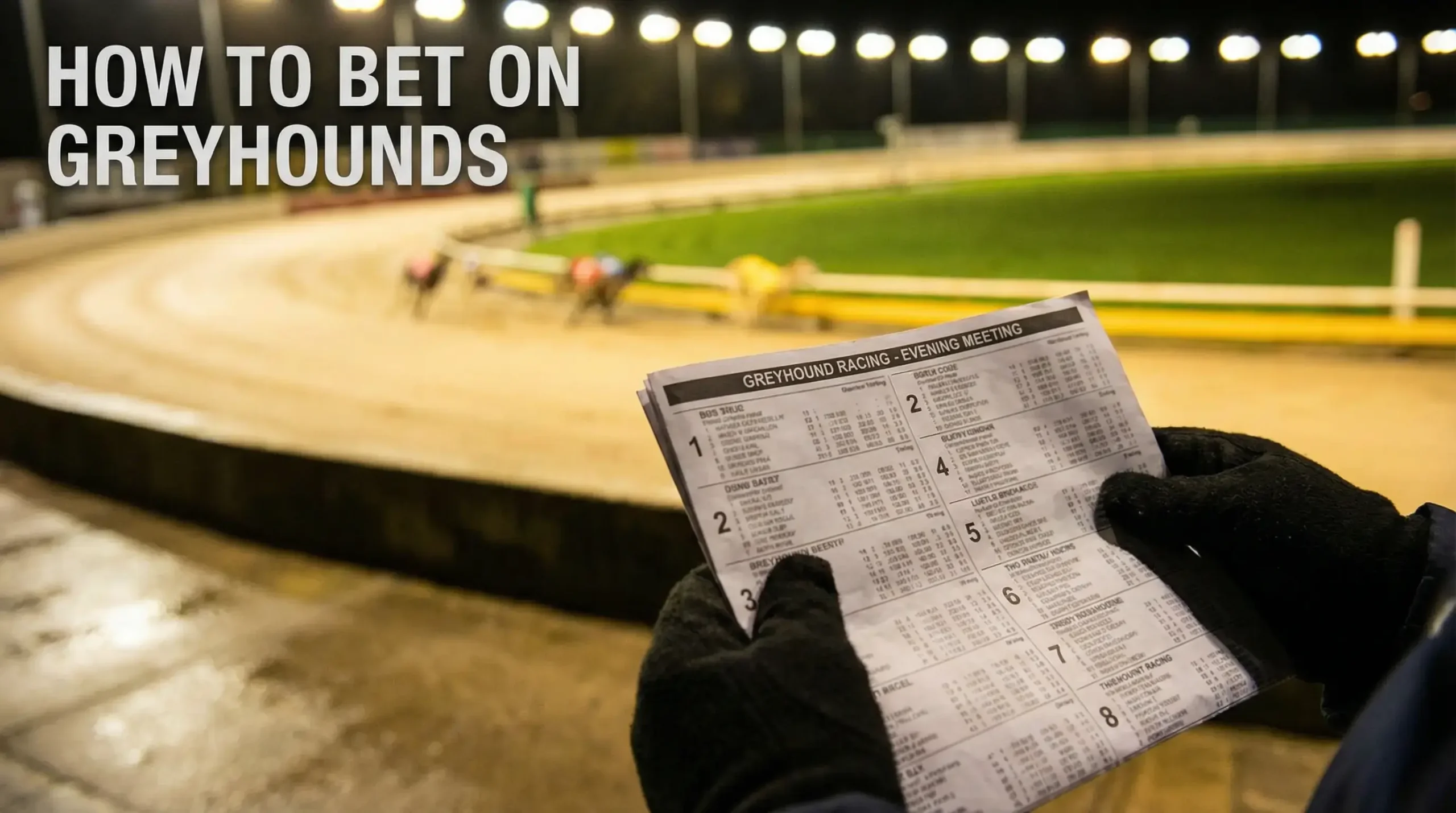
- Greyhound Betting in 2026: Faster Markets, Same Fundamentals
- Getting Started: Account, Deposit, First Bet
- Every Greyhound Bet Type Explained
- Understanding Greyhound Racing Odds
- How to Place Your Bet: Online, App and On-Track
- Bookmaker Features That Matter for Greyhound Bettors
- Common Greyhound Betting Mistakes
- Beyond the Basics: Building Your Betting Edge
- Trust the Card, Not the Gut: A Better Way to Pick Dogs
Greyhound Betting in 2026: Faster Markets, Same Fundamentals
Greyhound betting hasn’t changed as much as people think — but the tools have. The core proposition remains what it has been since the first race at Belle Vue in 1926: six dogs, one trap each, and a mechanical hare that nobody catches. You back a dog, the traps open, and thirty seconds later you have a result. No jockey interference, no tactical riding, no going to the front three furlongs out and daring the rest to catch you. Greyhound racing is direct in a way that appeals to bettors who prefer outcomes shaped by measurable variables rather than human whim.
What has shifted, particularly in the last five years, is the infrastructure around that bet. Live streaming through bookmaker apps means you can watch every race from every GBGB-registered track in the UK without leaving your kitchen. Racecard data that once required a newspaper or a trip to the track is now available instantly — split times, calculated times, sectional positions, weight, trainer form. The data has always existed; the access has exploded. For the punter willing to engage with that information, the edge is more available than it has ever been.
This guide covers the full process of betting on UK greyhound racing, from opening an account to placing your first forecast. It is written for people who already understand that betting involves risk and want to approach it with more knowledge rather than less. If you have never placed a bet on the dogs, start here. If you have but want to sharpen your method, the later sections on odds, bookmaker features, and common mistakes are where the practical value lies.
One thing this guide will not do is promise you winners. Greyhound racing is a sport with a genuine element of unpredictability — six dogs converging on a first bend at forty miles per hour creates chaos that no form analysis can fully account for. What form analysis does is improve your probability of making a good bet, which is a different thing from making a winning bet. The distinction matters, and understanding it early will save you from the most expensive mistake in greyhound betting: confusing a loss with a bad decision.
Getting Started: Account, Deposit, First Bet
Before the traps open, the admin has to be done. Betting on greyhound racing in the UK requires an account with a licensed bookmaker, and that account must be verified before you can deposit funds or place bets. This is not optional. Under UK Gambling Commission regulations, every operator must verify your identity and age before allowing you to gamble. The process typically involves providing your name, address, date of birth, and a form of identification — a driving licence or passport is standard.
Opening an account takes a few minutes with most major bookmakers. The online process is largely identical across operators: enter your details, choose a username and password, confirm you are over eighteen, and submit. Some operators verify instantly using database checks; others require you to upload a photo of your ID. Once verified, you can deposit funds using a debit card, bank transfer, or one of several e-wallet services. Credit card deposits for gambling have been prohibited in the UK since April 2020, so do not expect that option to appear.
Your first deposit will often trigger a promotional offer — a free bet, enhanced odds, or a deposit match. These offers vary between bookmakers and change frequently, so there is no point detailing specific promotions here. What is worth noting is the general principle: read the terms before accepting. Many welcome offers come with wagering requirements or restrictions on which markets qualify. A free bet that can only be used on horse racing is not much help if your interest is greyhounds. Check the small print, use the offer if it suits you, and move on.
With the account open and funds deposited, placing your first bet is straightforward. Navigate to the greyhound racing section — usually listed under “Greyhounds” or “Dogs” in the sports menu — select a meeting, choose a race, and click on the dog you want to back. The selection appears on your bet slip with the current odds. Enter your stake, confirm, and the bet is placed. The mechanics are identical whether you are using a desktop browser, a mobile app, or a self-service terminal in a betting shop. The only variable is the interface.
If you are betting on-track at a GBGB stadium, the process is marginally different. You can place bets with on-course bookmakers who display their odds on boards, or use the Tote — the pool betting system that calculates dividends after the race based on the total money wagered. On-course betting has a social dimension that online betting lacks, and if you have never been to a greyhound meeting, the experience of watching live racing while placing bets at the track is worth doing at least once.
Every Greyhound Bet Type Explained
Each bet type exists because someone wanted a different way to win. The simplest greyhound bet is the win single — pick the dog that crosses the line first. Everything else is a variation on that idea, adding complexity in exchange for larger potential returns or broader coverage of outcomes. Understanding what each bet type does, how the payout is calculated, and when it makes sense to use one over another is the foundation of competent greyhound betting.
Win, Place and Each Way Bets
A win bet is a stake on a single dog to finish first. If it wins, you are paid at the agreed odds. If it does not, you lose your stake. There is no partial return for finishing second or third. The simplicity is the appeal — one outcome, one price, one decision.
A place bet is a stake on a dog to finish in one of the designated placing positions. In a standard six-runner greyhound race, the place terms are usually first or second. Some bookmakers extend place terms for larger fields or specific promotions, but for the typical GBGB graded race with six runners, second place is the cut-off. Place bets pay reduced odds compared to a win bet, reflecting the higher probability of the outcome. If a dog is 5/1 to win, the place odds might be around 5/4 — one-quarter of the win price — depending on the bookmaker’s terms.
An each way bet combines a win bet and a place bet into a single wager. You are effectively placing two bets of equal stake: one on the dog to win at full odds, and one on the dog to place at a fraction of those odds. This means your total outlay is double the unit stake. A five-pound each way bet costs ten pounds — five on the win, five on the place. If the dog wins, both parts pay out. If it places but does not win, only the place part returns. If it finishes outside the placing positions, both parts lose.
Each way betting is most useful at longer odds. A dog at 8/1 each way gives you a place bet at 2/1, which provides a meaningful return if the dog finishes second. A dog at 6/4 each way gives you a place bet at roughly 3/8 — odds-on for a place finish, which means you need the dog to place more than seventy per cent of the time just to break even on the place portion. As a general principle, each way works at 4/1 and above. Below that, a straight win bet is usually more efficient.
Forecast, Tricast and Combination Bets
A forecast bet asks you to predict the first two finishers in the correct order. You name Dog A to win and Dog B to finish second. If the result is exactly that, the bet wins. Any other order, or any other dogs filling the first two places, and the bet loses. The payout is calculated after the race using the computer straight forecast dividend, which is based on the starting prices of the first two finishers. Because you are predicting two outcomes rather than one, forecast payouts are typically much larger than a simple win bet — often twenty to one or higher.
A reverse forecast covers both possible finishing orders for two selected dogs. You pick Dog A and Dog B, and the bet pays out whether A beats B or B beats A, so long as they fill the first two places. The cost is two units — you are funding both permutations. The payout is the CSF dividend for whichever order occurs, minus the cost of the losing permutation. Reverse forecasts are useful when you believe two dogs are clearly the best in the race but cannot separate them.
A tricast extends the concept to the first three finishers in order. In a six-runner race, there are one hundred and twenty possible permutations of the first three places, so the chance of landing a straight tricast is low. The rewards, when it hits, can be substantial — three-figure returns on a one-pound stake are not uncommon. A combination tricast covers all six permutations of three selected dogs finishing first, second, and third, at a cost of six times the unit stake.
There are also combination forecasts, where you select three or more dogs and cover every possible first-and-second combination. With three selections, that is six permutations. With four, it is twelve. The cost multiplies quickly, so combination forecasts work best when you can narrow the field to three genuine contenders and the rest of the runners are unlikely to place. The more permutations you cover, the higher the cost — and the lower the profit if the dividend is modest.
Understanding Greyhound Racing Odds
Odds are a language — learn it once, use it forever. Every price next to a dog’s name on a racecard or a bookmaker’s board is a statement about probability, filtered through the bookmaker’s need to guarantee a margin. The odds do not tell you who will win. They tell you what the market thinks, and the market is sometimes wrong. That gap between what the market thinks and what actually happens is the entire basis for profitable betting.
Fractional Odds and How to Read Them
Fractional odds are the traditional format in UK betting and the one you will encounter most frequently on greyhound racecards, in betting shops, and on British-facing bookmaker sites. They are expressed as one number over another: 5/1, 7/2, 11/4, 6/4, 4/6. The first number is the profit relative to the second number, which represents the stake.
At 5/1, you receive five pounds of profit for every pound staked, plus your original stake back — a total return of six pounds per pound bet. At 7/2, the profit is three pounds fifty per pound staked. At 4/6 — an odds-on price — you receive sixty-seven pence profit for every pound staked. Anything where the first number is larger than the second means the dog is considered less likely to win. When the first number is smaller, the dog is odds-on — the market rates it as more probable than not.
Decimal odds, increasingly common on exchanges and online platforms, express the total return per unit staked. A decimal price of 6.00 is the same as fractional 5/1 — a one-pound bet returns six pounds in total. The conversion is straightforward: divide the first fraction number by the second and add one. Decimal odds simplify the mental arithmetic, which is why many online bettors prefer them for quick calculations. A ten-pound bet at 3.50 returns thirty-five pounds. No fractions, no reduction — just multiplication.
Every set of odds implies a probability. At 5/1 (6.00 decimal), the implied probability is 16.7 per cent. At 2/1, it is 33.3 per cent. At evens, 50 per cent. If you add the implied probabilities of all six dogs in a race, the total will exceed 100 per cent — typically by 15 to 25 percentage points. That excess is the bookmaker’s margin, the built-in edge that ensures profit regardless of the outcome. A lower overround means better value for the punter. Betting exchanges, where you bet against other people rather than a bookmaker, typically offer lower margins, though liquidity on greyhound markets can be thin.
Starting Price, Early Price and Best Odds Guaranteed
When you place a bet, you have a choice between taking the current price or accepting the starting price. The starting price — the SP — is the odds available at the moment the race begins, determined by market activity. The early price is whatever the bookmaker is offering when you place your bet, which could be hours before the race.
The difference matters because odds move. Money coming in on a dog shortens its price. Information — a trainer’s recent form, a favourable draw, a weight change — flows into the market and shifts the numbers. If you take an early price of 5/1 and the dog is backed down to 3/1 by race time, you hold the better price. If the dog drifts to 8/1, you are stuck with the shorter number. Timing your bet is a judgement call that depends on whether you expect the price to shorten or lengthen.
Best odds guaranteed — commonly abbreviated to BOG — removes much of this dilemma. Under BOG terms, if you take an early price and the starting price is higher, the bookmaker pays you at the SP instead. You get the best of both worlds: the security of locking in a price with the upside of any market drift in your favour. Not every bookmaker offers BOG on greyhound racing, and some restrict it to certain meetings or bet types. Checking whether your bookmaker provides BOG for greyhounds is one of the most practical things you can do before placing a bet. It costs you nothing and can meaningfully increase your returns over a season.
How to Place Your Bet: Online, App and On-Track
The mechanics are different, the logic is the same. Whether you are tapping a bet slip on your phone, clicking through a desktop interface, or handing cash to an on-course bookmaker, the bet itself is identical: a stake at an agreed price on a specified outcome. The only things that change are the interface, the speed, and the social context.
Online betting through a desktop browser is the format that gives you the most screen space and the easiest access to form data alongside the betting interface. Most major bookmakers display racecards, recent form, trap draw information, and live streaming on the same page, allowing you to assess and bet without switching between tabs. The bet slip sits in a sidebar or pop-up panel: click on the dog, enter your stake, select your bet type, and confirm. Winnings are credited to your account within minutes of the race settling.
Mobile apps replicate the desktop experience in a compressed format. The major UK bookmakers all offer dedicated greyhound sections within their apps, with live streaming, racecards, and one-tap betting. The convenience is obvious — you can place a bet from anywhere with a phone signal. The trade-off is screen size. Reviewing detailed form data on a five-inch screen is less comfortable than on a monitor, and the temptation to bet quickly without proper assessment is higher. The app makes betting frictionless, which is a benefit when you have done the work and a liability when you have not.
On-track betting has its own rhythm. At a GBGB stadium, you can bet with on-course bookmakers who display odds on boards around the track. You tell the bookmaker your selection and stake, hand over the cash, and receive a ticket. If your dog wins, you return to the bookmaker with the ticket to collect. The alternative is the Tote — the pool betting operator that offers win, place, forecast, and jackpot bets with dividends calculated from the total pool. On-course Tote dividends are sometimes better than bookmaker odds, sometimes worse — the result depends on how the pool money has been distributed across the runners.
Self-service betting terminals, found in most betting shops and at many tracks, offer a hybrid experience. You select your race, pick your dog, and confirm your bet on a touchscreen. The interface is typically fed by SIS or RPGTV coverage, so you can watch the race on the screen above the terminal. It is quick, anonymous, and requires no interaction with a cashier — which appeals to some punters and feels impersonal to others.
Bookmaker Features That Matter for Greyhound Bettors
Not all bookmakers treat greyhound racing the same. Some operators invest heavily in their greyhound product — detailed racecards, live streaming from every GBGB track, best odds guaranteed, and competitive early prices. Others treat it as an afterthought, offering basic markets with minimal form data and no streaming. The difference matters more than you might expect, because the quality of information available at the point of betting directly affects the quality of your decisions.
Live streaming is the single most important feature for regular greyhound bettors. Watching the race you are betting on — seeing how the traps open, how the dogs navigate the first bend, where trouble occurs — gives you information that no racecard can provide. It also lets you build a visual memory of individual dogs and tracks that improves your form reading over time. A bookmaker that offers comprehensive greyhound streaming from all GBGB meetings, accessible through a funded account or a small qualifying bet, is providing a tool that has genuine analytical value.
Best odds guaranteed, as discussed earlier, is the second feature worth prioritising. It eliminates the downside of taking an early price and captures any upward drift in the market. Over a season of regular betting, BOG can add several percentage points to your overall return compared to betting at fixed early prices without the guarantee. It costs you nothing to use and requires only that you check whether the feature is active on greyhound markets.
Racecard depth varies significantly between operators. The best bookmaker racecards display full form lines including split times, calculated times, sectional positions, weight, trainer details, and race comments. The worst show only the dog’s name, trap number, and basic form figures. If your bookmaker’s racecard is bare, supplement it with a dedicated form service — sites like Timeform or specialist greyhound databases that provide the data you need for serious analysis.
Other features to consider include cash-out options, which let you settle a bet before the race finishes at a guaranteed figure; greyhound-specific promotions such as enhanced place terms or money-back specials on certain race types; and the availability of forecast and tricast markets on every meeting, which not all bookmakers offer consistently. None of these is a dealbreaker on its own, but the cumulative effect of choosing a bookmaker that serves greyhound bettors well rather than grudgingly is a marginal gain that compounds over time.
Common Greyhound Betting Mistakes
The fastest way to lose at the dogs is to skip the racecard. It sounds obvious, but the majority of greyhound bets are placed with minimal form analysis — a glance at the trap numbers, a check of the favourite’s price, and a punt. This approach works occasionally, because greyhound racing produces enough random variation that even an uninformed bet will land from time to time. Over any meaningful sample, it is a losing strategy.
Backing the favourite by default is the most common form of lazy betting in greyhound racing. Favourites in GBGB graded races win around 30 to 33 per cent of the time — less than one race in three. That figure is lower than most punters assume, and it means that blind favourite backing is a guaranteed long-term loss once the bookmaker’s margin is accounted for. The favourite deserves consideration, not automatic support. Sometimes it is a strong bet. Often, the price does not reflect the actual probability once you factor in trap draw, running style, and recent form.
Ignoring the trap draw is another expensive habit. The trap a dog is drawn in directly affects its chances, particularly over sprint distances and at tracks with tight first bends. A confirmed rails runner drawn in trap six faces a structural disadvantage that no amount of natural ability can fully overcome. The racecard tells you the dog’s running style and its allocated trap. If the two do not match, that should lower your assessment, regardless of how impressive the recent form looks in isolation.
Chasing losses is the behavioural mistake that causes the most damage. After a losing run, the temptation to increase stakes or bet on races you have not properly assessed is strong and almost always counterproductive. Greyhound racing offers ten or more races per meeting, with multiple meetings per day. The volume of opportunity creates the illusion that the next race can recover what the last one cost. It cannot — not reliably, and not through impulsive betting. The disciplined response to a losing streak is to reduce stakes or stop betting entirely until the next meeting you have properly prepared for.
Finally, neglecting calculated times in favour of raw finishing times distorts every comparison you make. A dog that ran 29.2 on a fast track and a dog that ran 29.6 on heavy going may have delivered identical performances once the going allowance is applied. Comparing raw times without adjusting for conditions is like comparing two runners’ times without noting that one ran uphill. The data is there to correct this. Use it.
Beyond the Basics: Building Your Betting Edge
The punter who studies form doesn’t guarantee profit — but they guarantee informed risk. Moving from casual betting to something more structured does not require a degree in statistics. It requires consistency: the willingness to check the same data points before every bet and to record enough of your activity to know whether your approach is working.
The first step is specialisation. Greyhound racing in the UK runs across more than twenty tracks, with multiple meetings every day of the week. No one can follow all of them with the depth required for informed betting. Choosing two or three tracks and learning their characteristics — the trap biases, the typical split times, which trainers are in form, how the bends ride — produces better decisions than spreading your attention thinly across every meeting on the schedule. A punter who knows Romford inside out will find more value at Romford than a generalist who bets on whichever meeting happens to be streaming.
Sectional analysis is the next layer. Finishing times tell you the result. Sectional times — the split from the traps to the line on the first pass — tell you how the race developed. A dog with a fast split that was crowded at the first bend and finished fourth has run a better race than the bare result suggests. The market prices future races on finishing positions. The form student prices them on sectionals, race comments, and the context behind each result. That difference in method produces a different assessment, and when the market’s assessment is wrong, the form student finds value.
Recording your bets is the least glamorous part of building an edge and the most important. A simple log — date, meeting, race, selection, odds, stake, result — tells you over fifty or a hundred bets whether your selections are profitable at the prices you are taking. Without that record, you are guessing at your own effectiveness. Most punters overestimate their win rate and underestimate their losses, because memory is selective and the big wins are more vivid than the steady accumulation of small losses. The spreadsheet does not lie.
Bankroll management sits alongside record-keeping as a structural discipline. Decide on a unit stake — typically one to two per cent of your total betting bankroll — and stick to it. Do not increase stakes after a win to press the advantage. Do not increase stakes after a loss to chase the recovery. Flat staking across a consistent unit keeps your bankroll stable enough to survive the losing runs that every bettor experiences and ensures that winning runs are not undermined by reckless sizing on losing bets.
Trust the Card, Not the Gut: A Better Way to Pick Dogs
Intuition is just pattern recognition you haven’t audited yet. Every experienced greyhound punter develops a feel for races — a sense that a particular dog looks right in a particular field, a gut instinct that the 5/1 shot is the one. That instinct is not worthless. It is built on hundreds of races watched and thousands of results absorbed, and it sometimes picks up signals that the conscious mind has not fully processed.
The problem is that it also picks up noise. The human brain is built to find patterns even where none exist, and to give disproportionate weight to vivid recent memories. The dog that produced a spectacular win last week is more salient in your memory than the three unplaced runs before it. The trap that won the last two sprints at Crayford feels hot, even though the sample is far too small to mean anything. Instinct works until it encounters its own bias, at which point it starts costing you money without telling you why.
The racecard is the corrective. It does not care about your last bet or your favourite trap or the dog whose name you like. It records times, positions, splits, comments, weights, and grades — data that can be compared, adjusted, and tested against the odds. The punter who trusts the card over the gut is not eliminating instinct. They are disciplining it, running every hunch through a filter of evidence before it becomes a bet.
This does not make greyhound betting mechanical or joyless. The races are still fast, still chaotic, still capable of producing results that no analysis predicted. The thrill of a dog surging through on the outside off the last bend is undiminished by the fact that you spotted the opportunity in the sectionals rather than the stars. If anything, the satisfaction is greater — because you made a decision for identifiable reasons, and those reasons proved sound. That is a better foundation for long-term betting than any instinct can provide.
Learn how to bet on greyhounds on the livegreyhoundtoday homepage.
Explore all bet types in detail in bet types.
