
Best Greyhound Betting Sites – Bet on Greyhounds in 2026
Loading...
Not a Dog in Sight
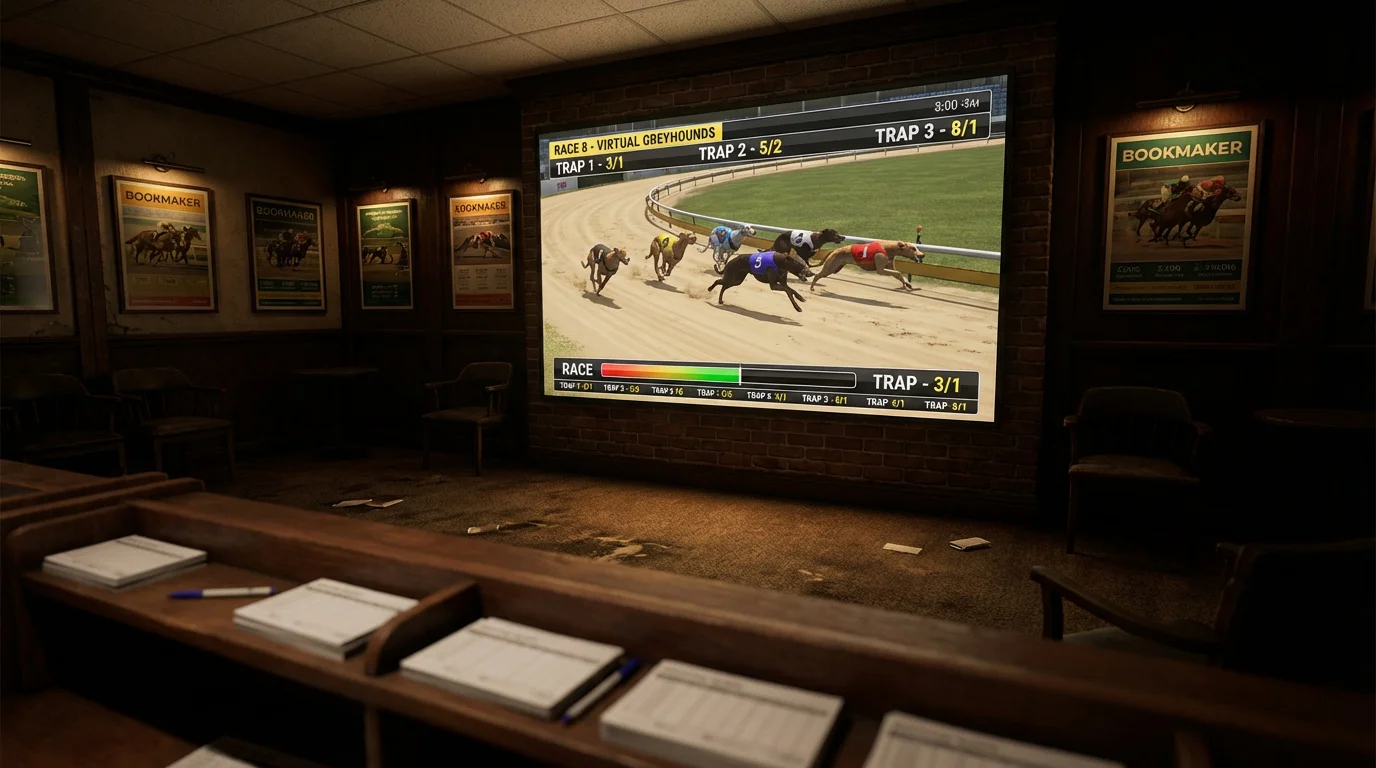
Virtual greyhound racing looks like greyhound racing. The screen shows six dogs, each assigned a trap number and a set of odds. A commentator calls the action. The dogs break from the traps, navigate the bends, and cross the finish line in an order that determines which bets win and which lose. The presentation mimics the real thing convincingly enough that a casual observer might not immediately spot the difference.
The difference is fundamental. There are no dogs. No track. No form to study, no draw to analyse, no trainer to assess. Virtual greyhound racing is a computer-generated animation overlaid on a random number generator, and the outcome of every race is determined by software before the animated dogs leave the virtual traps. The race you are watching is a visual representation of a result that has already been calculated. The animation is decoration. The algorithm is the product.
This does not make virtual greyhound racing illegitimate. It is a licensed, regulated betting product offered by every major UK bookmaker. But it makes it a fundamentally different activity from betting on live greyhound racing, and understanding the distinction is essential for anyone who encounters virtual races on a bookmaker’s platform — which, given their prominence, includes most people who bet on greyhounds at all.
How Virtual Greyhound Racing Works
Virtual greyhound races are produced by specialist gaming companies — Inspired Entertainment and Leap Gaming are among the most prominent providers in the UK market — and licensed to bookmakers for distribution through their retail and online platforms. The bookmaker hosts the product. The gaming company produces the races.
Each virtual race is generated independently. A random number generator determines the finishing order before the race animation begins. The RNG assigns each of the six runners a performance value based on weighted probabilities, and these values produce the result. The animation is then generated to match that result, creating the visual impression of a race with overtaking, close finishes, and dramatic late runs. Everything you see on screen was scripted by the algorithm.
New races are generated at fixed intervals — typically every two to four minutes, depending on the product and the bookmaker. This frequency is dramatically higher than live racing, where races are spaced ten to fifteen minutes apart. The rapid schedule is by design. Virtual racing fills the gaps between live events and provides a continuous stream of betting opportunities for customers who want action regardless of the live sporting calendar.
The races carry names, trap colours, and sometimes fictional dog names to create the appearance of a sporting event. Some virtual products assign each runner a set of fictional attributes — early pace, stamina, a preferred running style — which are displayed alongside the odds. These attributes are cosmetic. They may influence the visual animation, but the outcome is determined by the RNG’s probability weighting, not by a simulation of fictional form.
The visual quality of virtual greyhound racing has improved considerably in recent years. Modern products use three-dimensional animation with realistic movement, camera angles that mimic broadcast coverage, and commentary that responds dynamically to the race. The gap between the appearance of a virtual race and a real one has narrowed to the point where the distinction is primarily conceptual rather than visual.
The RNG: Understanding Random Outcomes
The random number generator at the heart of every virtual greyhound race is the only element that matters. Everything else — the animation, the odds display, the fictional form — exists to present the RNG’s output in an entertaining format. Understanding the RNG tells you everything you need to know about what you are betting on.
An RNG produces outcomes according to predetermined probability weightings. In a virtual greyhound race, the favourite — the runner with the shortest odds — has a higher probability of winning than the outsider. This probability mirrors what you would expect in live racing: shorter-priced runners win more often than longer-priced ones. The difference is that in live racing, the probability is estimated by the market based on form and conditions. In virtual racing, the probability is defined by the software and is exact.
This has a critical implication. In live racing, skilful form analysis can identify runners whose true probability of winning exceeds their market-implied probability. This is the definition of value, and it is the mechanism by which knowledgeable bettors generate profit over time. In virtual racing, no such analysis is possible. The probabilities are fixed by the algorithm. The odds reflect those probabilities minus the bookmaker’s margin. There is no form to read, no angle to exploit, and no information that could give one bettor an edge over another.
The RNG is certified by independent testing laboratories — bodies like GLI and eCOGRA — to ensure fairness and randomness. The outcomes must be genuinely unpredictable and must match the probability distribution declared by the provider. This means the product is fair in the sense that it delivers what it promises. It also means the house edge is mathematically embedded and cannot be overcome through skill.
Betting on Virtual Greyhounds
The betting interface for virtual greyhound racing mirrors the live product closely. You can place win bets, each way bets, forecasts, and tricasts. The odds are displayed for each runner, and the bet types are settled in the same way — win at full odds, each way at a fraction of the win odds for a place, forecasts and tricasts based on the combination of finishing positions.
The key difference is that the odds on a virtual race are set by the provider’s software and do not move. There is no market in the traditional sense — no weight of money shifting the prices, no opening show, no drift or shortening. The odds you see when the race appears on screen are the odds you get. This simplifies the betting process but removes any possibility of identifying value through price movement or market analysis.
The house margin on virtual greyhound racing is typically higher than on live racing markets. A live greyhound race at a competitive bookmaker might carry an overround of 115 to 125 percent. A virtual race commonly operates at 130 to 140 percent or higher. This means that for every pound wagered across all outcomes, the bookmaker retains a larger share than on the equivalent live event. The higher margin is the cost of the convenience and frequency that virtual racing provides.
Minimum and maximum stakes on virtual greyhound betting are generally similar to live racing, though maximum payouts may be capped at lower levels. The specific limits vary by bookmaker and by bet type. Check the terms before placing a significant wager on a virtual event, particularly on forecast and tricast bets where the theoretical return can be high.
Virtual vs Live: What You Gain, What You Lose
Virtual greyhound racing offers three things that live racing cannot: availability, speed, and certainty of scheduling. Races run every few minutes, twenty-four hours a day in some cases, and are never cancelled for weather, track conditions, or fixture clashes. If you want a greyhound race to bet on at three in the morning, virtual racing provides one.
What virtual racing cannot offer is the dimension that makes live greyhound betting intellectually rewarding: the opportunity to be right through analysis. In live racing, your knowledge of form, draw, pace, trainers, weights, and track bias gives you a potential advantage over less informed bettors and over the market itself. This advantage does not exist in virtual racing. The RNG cannot be outperformed by research. Every bet is a pure probability play against a fixed house edge, which means that over any extended period, the expected return is negative.
This is not a moral judgement. Virtual greyhound racing is a legitimate entertainment product, and if you enjoy the visual spectacle and the quick-fire betting rhythm, it delivers what it promises. The point is clarity about what the product is. It is closer to a casino game with a racing theme than to a sporting event where knowledge provides an edge. Treating it as an extension of your live greyhound betting — applying the same staking plans, the same analytical habits, the same expectation of findable value — is a category error that the rapid-fire schedule is perfectly designed to exploit.
The Virtual Verdict
Virtual greyhound racing exists because bookmakers need content and customers want action between live events. It fulfils both needs efficiently. The product is fair, the presentation is polished, and the betting experience is familiar enough to feel like the real thing.
But it is not the real thing. The gap between virtual and live greyhound racing is the gap between entertainment and analysis, between luck and edge, between playing a game and studying a sport. If you enjoy virtual racing as a standalone product and manage your stakes accordingly, it is a perfectly reasonable way to spend a few minutes. If you are a form student who bets on greyhound racing because you believe your analysis gives you an advantage, virtual racing offers you nothing that your skills can exploit.
The distinction matters because the two products sit side by side on every bookmaker platform, separated by a tab or a scroll. It is easy to finish a live card, notice a virtual race loading in three minutes, and carry your betting momentum into a product where that momentum has no analytical backing. Knowing where the boundary falls — and staying on the side of it where your skills count — is a small but genuine act of discipline.