Best Greyhound Betting Sites – Bet on Greyhounds in 2026
Loading...
Draw, Draw, Draw
Ask any greyhound professional their top three factors when assessing a race. The answer, more often than not, comes back the same way: draw, draw, draw. It is a cliche in the sport because it is true. No single variable influences the outcome of a greyhound race more consistently than where each dog starts.
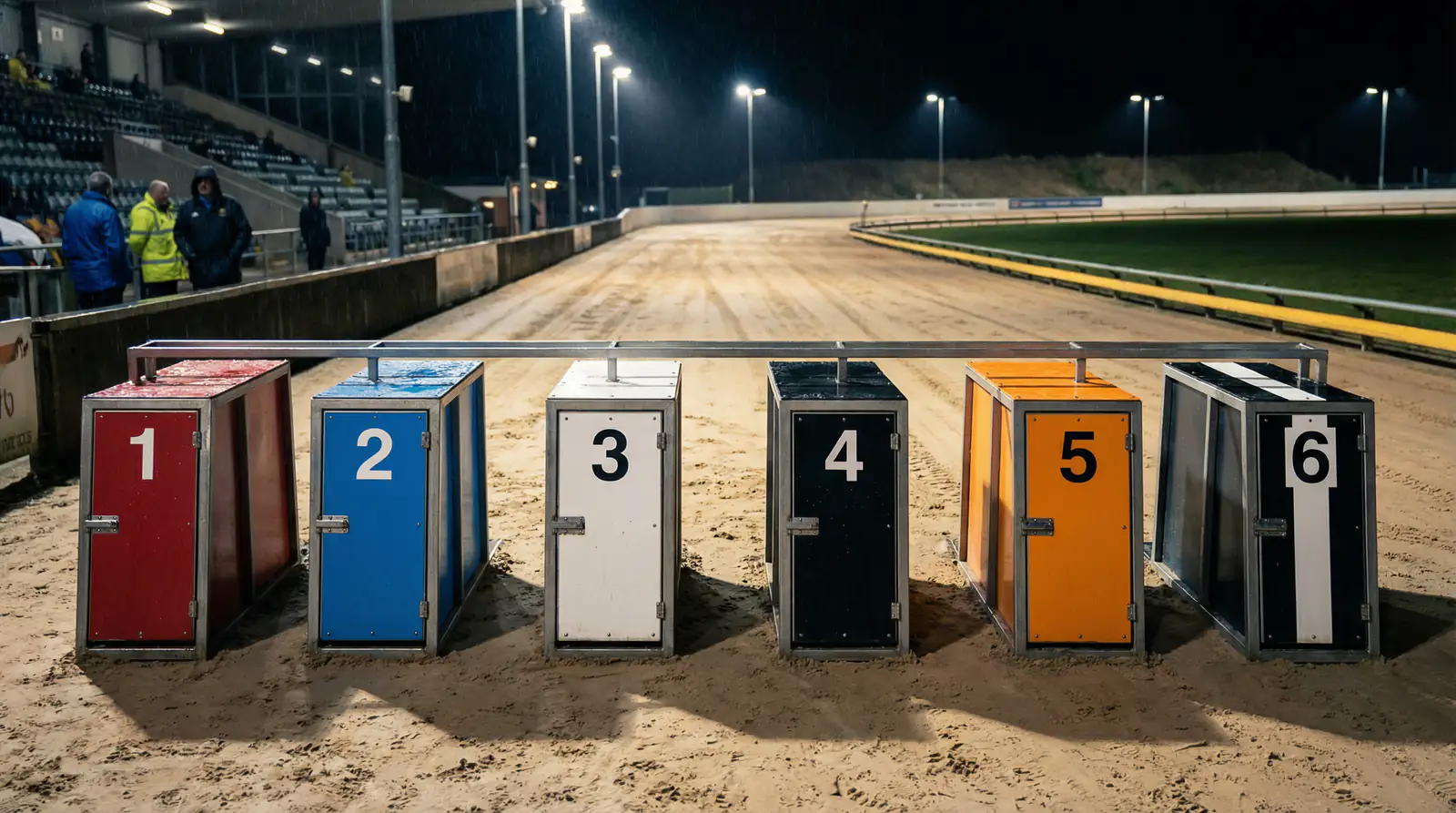
A greyhound race is not run in lanes. Six dogs break from numbered traps and immediately compete for the same strip of track heading into the first bend. The dog’s starting position — trap one on the inside rail through to trap six on the outside — determines its path to that bend, and by extension its path through the rest of the race. A dog that clears the first turn in front, or at least without interference, has a statistically dominant chance of winning. A dog that gets crowded, baulked, or forced wide at the first bend is fighting uphill from that moment on.
This is why the trap draw matters more in greyhound racing than it does in almost any other sport with a staggered or positional start. In horse racing, a wide draw can be compensated by tactics, distance, and the sheer length of the race. In greyhound racing, the entire contest can be decided in the first four seconds. The draw sets the terms for those four seconds.
For bettors, the practical consequence is straightforward. You cannot assess a greyhound’s chance in a race without first assessing its draw. A fast dog in the wrong trap is a different proposition entirely from the same dog in the right one. Learning to read the draw is not an advanced skill reserved for expert punters. It is the first skill, and possibly the most important one you will develop.
How Trap Draws Are Allocated
It’s not random — except when it is. The way traps are allocated in UK greyhound racing depends on the type of race, and understanding the distinction is essential to reading the draw correctly.
In graded races, the racing manager at each track allocates traps based on each dog’s running style and seeding, in accordance with GBGB racing rules. Greyhounds are categorised by the position they naturally adopt during a race. A railer — a dog that runs close to the inside rail — will typically be seeded into traps one or two. A middle runner gets traps three or four. A wide runner, marked with a “w” on the racecard, draws five or six. The racing manager’s job is to construct a fair, competitive race by placing each dog in a trap that suits its natural running line.
This seeding system means that graded racecards are not drawn at random. They are constructed. A well-seeded race gives each dog a reasonable chance of getting a clear run to the first bend, because adjacent runners should be heading in compatible directions. When a railer is in trap one and a wide runner is in trap two, the wide runner will move outward at the start, giving the railer room to hug the rail. The system is designed to reduce crowding.
Open races operate differently. Here, traps are drawn by random ballot. There is no seeding, no accommodation for running style. A committed railer can end up in trap six. A wide runner can find itself in trap one. These random draws are what create the most dramatic draw mismatches, and by extension the most interesting betting opportunities. When you see an open race on the card, the first thing to check is whether any runner has been drawn badly against its natural running preference.
Handicap races, trials, and some special events follow their own draw rules, but the vast majority of the UK greyhound programme consists of graded and open races. Knowing which type you are looking at — and therefore whether the draw has been managed or randomised — is the first step in any draw analysis.
Railers, Middles and Wide Runners
Running style defines trap preference. Every greyhound has a natural inclination to run on a specific part of the track, and this inclination is one of the most consistent behavioural traits in the sport. Some dogs hug the rail from the moment the traps open. Others drift wide and prefer the extra room on the outside. The rest sit somewhere in between.
Railers are typically marked with no additional notation on the racecard — an unseeded dog defaults to the rail classification. Middle runners carry an “m” next to their name. Wide runners carry a “w”. These designations are assigned by the racing office and reflect the dog’s observed behaviour over multiple races. They are not theoretical. If a dog is marked as a wide runner, it runs wide. Expecting it to suddenly hug the inside rail because it has drawn trap one is a losing bet waiting to happen.
The physical mechanics are worth understanding. At the start, all six dogs accelerate from stationary to near top speed — around 45 miles per hour — within the first few strides. As they approach the first bend, each dog moves toward its preferred running line. Railers cut inward. Wides drift outward. If a dog’s starting position aligns with its preferred running line, it reaches that line with minimal lateral movement and maximum forward momentum. If its starting position conflicts with its preference, it spends the critical early strides moving sideways rather than forward, losing ground and potentially causing interference with neighbouring dogs.
This is why a railer in trap one is in its ideal position: the rail is right there, no lateral movement required. That same railer in trap four has three dogs between it and the rail, and its instinct to cut inside can create crowding at the first bend. Conversely, a wide runner in trap six has open track to its outside and a clean path to the wide racing line. In trap two, it needs to get past four other dogs to reach its preferred position.
The interaction between running styles within a single race is what makes draw analysis genuinely interesting. Two railers drawn in traps one and two will compete for the rail, and the one with sharper early pace will typically get there first. A railer in trap one next to a wide runner in trap two is a gift — the wide runner moves away, the railer has the rail to itself. Mapping these interactions across all six traps is the heart of race-reading.
Spotting Draw Mismatches
When a railer draws five, that’s not bad luck — it’s your cue. Draw mismatches are the most immediately actionable piece of information on a greyhound racecard, and they occur with regularity in open races where traps are allocated by ballot rather than seeding.
A draw mismatch exists whenever a dog’s trap position conflicts with its natural running style. The most obvious examples are a committed railer drawn in trap five or six, or a wide runner drawn in trap one or two. But subtler mismatches matter too. A middle runner in trap one who needs to move slightly outward can interfere with the dog in trap two. A railer in trap three with two slow-away dogs inside it might actually get a clear run to the rail despite the apparently unfavourable draw.
The value in spotting mismatches comes from the market’s tendency to underreact. Casual punters look at form — recent times, wins, and finishing positions — and give less weight to the draw. When a recent winner draws unfavourably in an open race, the market often still prices that dog as if it has a strong chance based on its form line. The draw handicap is not fully reflected in the odds. This is where informed bettors find edges.
Working the other direction is equally profitable. A dog that has been finishing third or fourth in recent races but has run from poor draws might suddenly find itself in an ideal trap. The form looks mediocre, the price is generous, but the draw improvement changes the picture fundamentally. These are the dogs that sharp punters back while the crowd chases the recent winner from the wrong box.
To systematically spot mismatches, you need two pieces of information for every dog in the race: its running style designation (railer, middle, wide) and its trap history over recent starts. If a dog has raced exclusively from traps one and two in its last six runs and is suddenly in trap five, that is a mismatch. Check the reason. If it is an open race ballot, the mismatch is genuine and the dog’s chance may be significantly impaired. If the racing manager has moved the dog deliberately, there may be a reason in the form you are not seeing.
Track-by-Track Trap Bias
Not all trap ones are created equal. Every greyhound track has its own geometry — the length of the run from the traps to the first bend, the tightness of the bends, the width of the straights — and these physical characteristics create measurable biases in trap performance.
At tracks with a short run to the first bend, inside traps have a natural advantage. The inside dog reaches the bend first by virtue of covering less ground, and if it has reasonable early pace, it can establish a lead before the field compresses. Romford is a classic example. The run-up is short, the bends are tight, and leaders from low traps win at a rate noticeably above statistical expectation. Crayford followed a similar pattern before its closure in 2025.
At tracks with a longer run to the first bend, the inside advantage is diluted. Dogs have more time to sort themselves out before the turn, and early pace from any trap becomes the dominant factor. Hove, with its longer straights and wider bends, rewards pace more than position. Newcastle provides a more galloping track where middle and wide runners can operate effectively.
Track bias data is publicly available through services like Timeform and the Racing Post, which publish trap statistics by track and distance. These numbers tell you the historical win rate for each trap position at a given venue. When trap one at a specific track wins 22 per cent of races and trap six wins 12 per cent, that disparity is not noise. It is a structural feature of the circuit that should inform your betting.
The practical application is to weight your draw analysis by track. A railer in trap one at Romford is in a stronger position than the same dog in trap one at Towcester, where the run-up is longer and the circuit characteristics are different. Track-specific knowledge is what separates a general understanding of draw from an actionable one.
Draw vs. Pace: Which Wins the Race
The best scenario is having both on your side. When the fastest dog out of the traps also has the ideal draw for its running style, the bet practically writes itself. But greyhound racing rarely presents such clean setups, and the more useful question is what happens when draw and pace point in different directions.
The honest answer is that it depends on the track. At venues where the first bend comes up quickly and tightly, draw tends to override pace. Even a slightly slower dog from trap one can hold the rail and shut the door on quicker rivals who have to negotiate traffic. At more open circuits, a dog with exceptional early pace can overcome a wide draw by sheer speed — getting to the bend in front regardless of where it started.
When forced to choose between a well-drawn dog with moderate pace and a badly drawn dog with brilliant pace, the percentages lean toward the draw at most UK tracks. The reason is interference. A fast dog from a poor draw still needs a clear path to express its pace, and in a six-runner field, clear paths are not guaranteed. A well-drawn dog with moderate pace at least has a clean line. It might not lead, but it will not lose ground through trouble.
The punters who do best with draw analysis are the ones who stop treating it as a tiebreaker and start treating it as a filter. Before you assess a dog’s form, times, or class, check its draw. If the draw is a serious handicap, you need an exceptional reason to back it. If the draw is favourable, you have a foundation on which to build a case. Draw does not guarantee anything. But it shapes every race, every time, and the bettor who ignores it is leaving information on the table.