
Best Greyhound Betting Sites – Bet on Greyhounds in 2026
Loading...
The Clock Inside the Clock
Every greyhound race produces a finishing time. That number sits at the end of each form line, and it is the first thing most punters compare when assessing a field. But the finishing time is a blunt instrument. It tells you how fast the winner ran the entire race without revealing anything about how the race unfolded within those seconds.
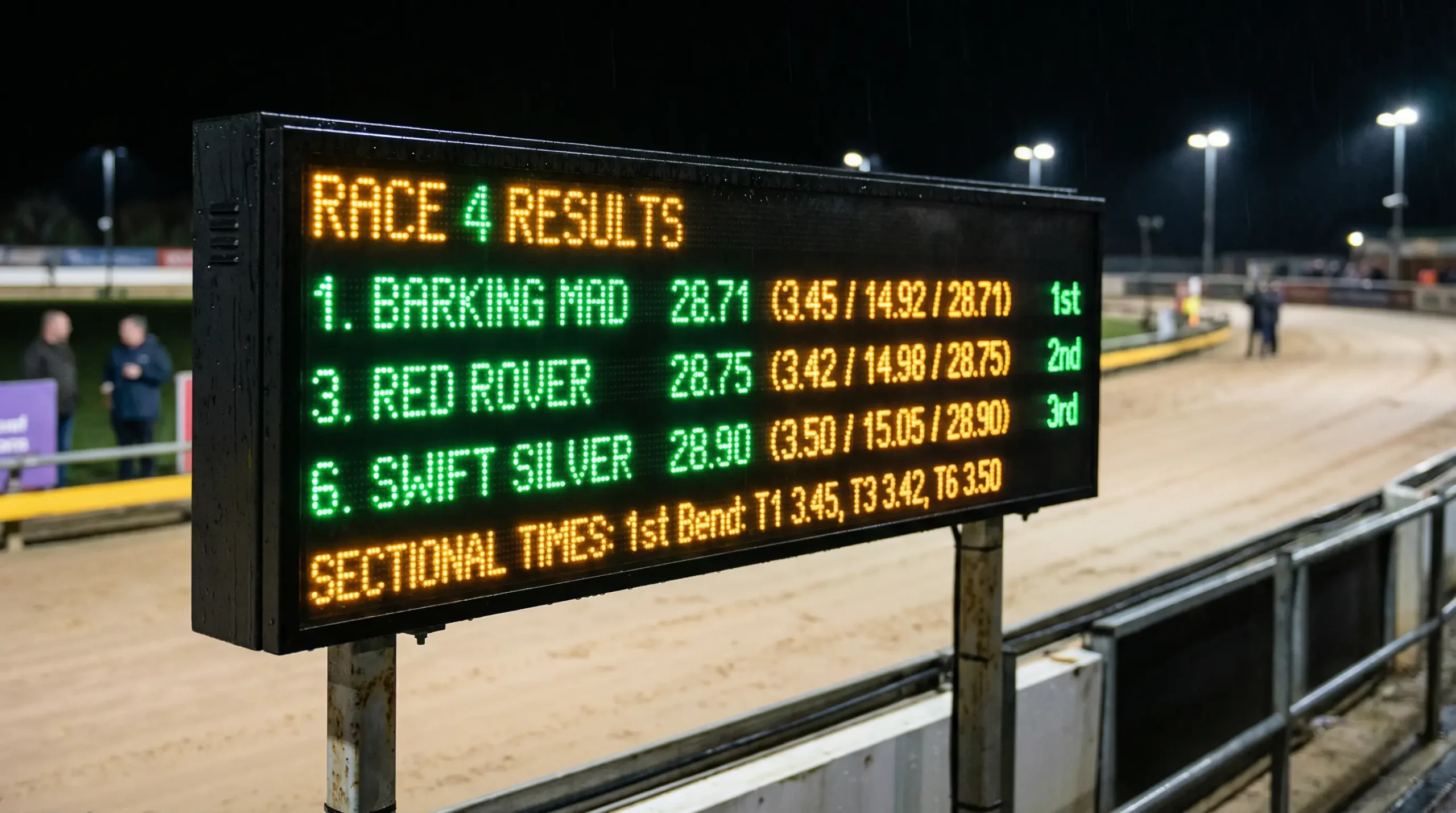
Split times break the race into segments. The most important of these is the sectional time from the traps to the finishing line on the first pass — the time it takes the dog to reach the line before completing the full circuit. This split, typically recorded to a hundredth of a second, captures the critical opening phase of the race: the break, the run to the first bend, and the initial positioning that shapes everything that follows.
For bettors, the split is frequently more informative than the overall time. Two dogs might finish a 480-metre race in identical times, but if one ran 4.52 to the first split and the other ran 4.71, their races were fundamentally different. The first dog was leading early and may have coasted home. The second was chasing from behind and may have been running fastest at the point where the race was already decided. Identical clock, entirely different stories.
Understanding split times transforms racecard analysis from surface-level comparison into something structurally useful. It does not require advanced statistics or proprietary tools. It requires the habit of looking at the split column before the finishing time, and knowing what the numbers actually mean.
What Split Times Measure
The split time — sometimes labelled STm or “split” on the racecard — records how long the dog took to travel from the starting traps to the finishing line for the first time. In standard four-bend races, the traps are positioned before the finish line, so the dogs cross the line once on their way out and again when they complete the full circuit. The split captures that first crossing.
The distance covered in the split varies by track and race distance. At a track where the standard trip is 480 metres, the traps might be positioned 100 metres before the finish line, meaning the split covers roughly 100 metres of running. At a track with a different configuration, the split distance will differ. This is why raw split times should only be compared between runs at the same track and distance. A 4.55 split at Romford and a 4.55 at Hove do not represent the same performance because the split distances are different.
What the split captures, regardless of track, is the dog’s early pace and its position relative to the field at a fixed point in the race. A fast split means the dog was travelling quickly in the opening strides and was near the front of the field as it approached the first bend. A slow split means it was further back. Because the first bend is the critical juncture in most greyhound races — the point where crowding, bumping, and positional losses occur — the split is effectively a proxy for how well the dog navigated the most important phase of the contest.
Racecards also display sectional placings, which record the dog’s position at each bend during the race. These work alongside the split to create a fuller picture. A dog with a fast split and sectional placings of 1-1-1-1 led from start to finish. A dog with a slow split and sectional placings of 5-4-3-2 was closing throughout and may have been the fastest dog in the race despite never leading. Both pieces of data contribute to the assessment, but the split is the starting point.
Comparing Splits Across Runners
The real utility of split times emerges when you compare them across the six dogs in a race. Each runner’s recent splits at the same track and distance are listed in the form, and laying them side by side reveals who is likely to lead to the first bend — the single most predictive piece of information in greyhound race analysis.
Start with the fastest recent split for each dog, then check the consistency. A dog with splits of 4.51, 4.53, and 4.55 over its last three runs is reliably quick early. A dog with splits of 4.48, 4.65, and 4.58 is erratic — brilliant on its day but unreliable. For betting purposes, the consistent dog is the safer assumption for leading early, even if the erratic dog has the single fastest split in the field.
Next, consider the trap draw. A fast split from trap one carries more weight than the same split from trap four, because the trap one dog reaches the rail with less lateral movement. If two dogs have comparable splits but one is drawn inside the other, the inside dog is more likely to establish position first. The split predicts speed; the draw determines whether that speed translates into clear running or a fight for room at the bend.
When one dog has splits consistently faster than every other runner in the field by two-tenths of a second or more, and it is drawn in a low trap, you are looking at a strong candidate to lead uncontested to the first bend. These dogs do not always win — trouble can still occur, and some dogs lead early but fade in the closing stages — but they clear the most dangerous obstacle in the race. Back them to win, or use them as the anchor in forecast bets.
Where splits are closely bunched — perhaps three dogs all within 0.05 seconds of each other — the race to the first bend becomes more contested and less predictable. These are the races where draw and running style matter more than raw split speed, because the dogs will arrive at the bend almost simultaneously. In these fields, the dog with the most favourable draw rather than the fastest split often emerges in front.
Going Adjustments and What They Change
Greyhound racing tracks are sand-based surfaces, and the condition of that surface changes with weather, maintenance, and usage. A track that has been rained on will run slower than one that is dry and well groomed. These variations affect every dog’s time in every race, which makes raw times unreliable for comparison across different days.
Going adjustments — also called going allowances — correct for this. Each meeting carries a going figure, expressed as a positive or negative number. A going allowance of minus ten means the track was running ten spots (hundredths of a second) slow on the night. A going allowance of plus five means it was running five spots fast. These adjustments are applied to the raw finishing time to produce a standardised figure that allows comparison across different meetings.
The adjustment is applied to the finishing time, not to the split time. This means that when you compare splits across different meetings, you need to be aware that the track conditions may have differed. A split of 4.58 on a night where the going was minus fifteen represents faster raw pace than a split of 4.55 on a night when the going was plus five. The surface was resisting the first dog more heavily.
In practice, most punters focus on split comparisons within the same meeting (where the going is constant for all runners) or between meetings with similar going figures. When the going varies significantly between two form lines, the split comparison becomes less reliable unless you manually adjust. Some data services do this for you, providing adjusted splits alongside raw ones. Where that data is available, use it. Where it is not, flag the going differential as a caveat rather than ignoring it entirely.
The going also affects certain dogs more than others. Lighter dogs tend to handle loose or wet surfaces better than heavier ones. Dogs with a strong early pace may maintain their advantage on a fast track but lose it on a slow one, where every stride costs more energy. These are subtleties that go beyond the basic adjustment and into genuinely useful form reading — connecting the conditions to the individual animal’s characteristics.
Calculated Time: The Adjusted Picture
The calculated time — often labelled “Calc Tm” on the racecard — is the finishing time adjusted for going. If a dog ran 29.85 on a night where the going was minus ten, its calculated time is 29.75. If the going was plus five, the calculated time is 29.90. The adjustment standardises times across meetings so you can compare performances on different nights as though the track conditions were identical.
Calculated times are the standard currency for assessing a dog’s raw speed. When the racecard highlights a best calculated time — often marked with an asterisk — it is flagging the fastest adjusted performance the dog has produced over that distance in recent outings. This figure is the one to compare across runners when evaluating which dogs have the highest ceiling of performance.
However, calculated time has limitations. It adjusts for the track surface but not for interference in running. A dog that was baulked at the second bend and lost two lengths will have a slower calculated time than a dog with a clear run, even if the baulked dog was the faster animal on the night. This is where the running comments complement the times. A calculated time read in isolation is a partial picture. A calculated time read alongside the race remarks column is a much more complete one.
The best recent calculated time also flatters dogs that have had one exceptional run among several mediocre ones. Consistency matters. A dog that runs 29.65, 29.70, and 29.68 in its last three starts is a more reliable proposition than one that ran 29.50 once but 30.10 on the other two occasions. The first dog’s range is narrow, suggesting a repeatable level of performance. The second dog’s range is wide, suggesting conditions-dependent ability. Both might show the same best calculated time if their single peak overlapped, but they are not equivalent betting propositions.
Splits as Edge: What the Numbers Miss
Split times and calculated times are powerful tools, but they measure output rather than context. A fast time tells you the dog ran quickly. It does not tell you whether it had a clear run, whether the draw helped or hindered, or whether the grade was above or below its natural level. The numbers are the starting point for analysis, not the conclusion.
The punters who extract genuine edge from timing data are the ones who combine it with everything else on the racecard. They check the split, note the draw, read the running comments, consider the grade, and then form a view. A dog with the fastest split in the field, drawn in trap one, with comments showing QAw and ALed in recent runs, competing at a newly downgraded level, is a qualitatively different proposition from a dog with the fastest split but drawn in trap six with two Crd comments in its last three runs.
The times give you a skeleton. The rest of the form gives you the flesh. Build both, and you have something worth betting on. Rely on times alone, and you are working with an incomplete picture. The racecard offers all the information you need. The split column is the best place to start reading it.