History of Greyhound Racing in the UK: From 1926 to Today
The history of UK greyhound racing — from Belle Vue 1926 to modern GBGB regulation, major derbies, legendary dogs, and how the sport has evolved.
 Available in US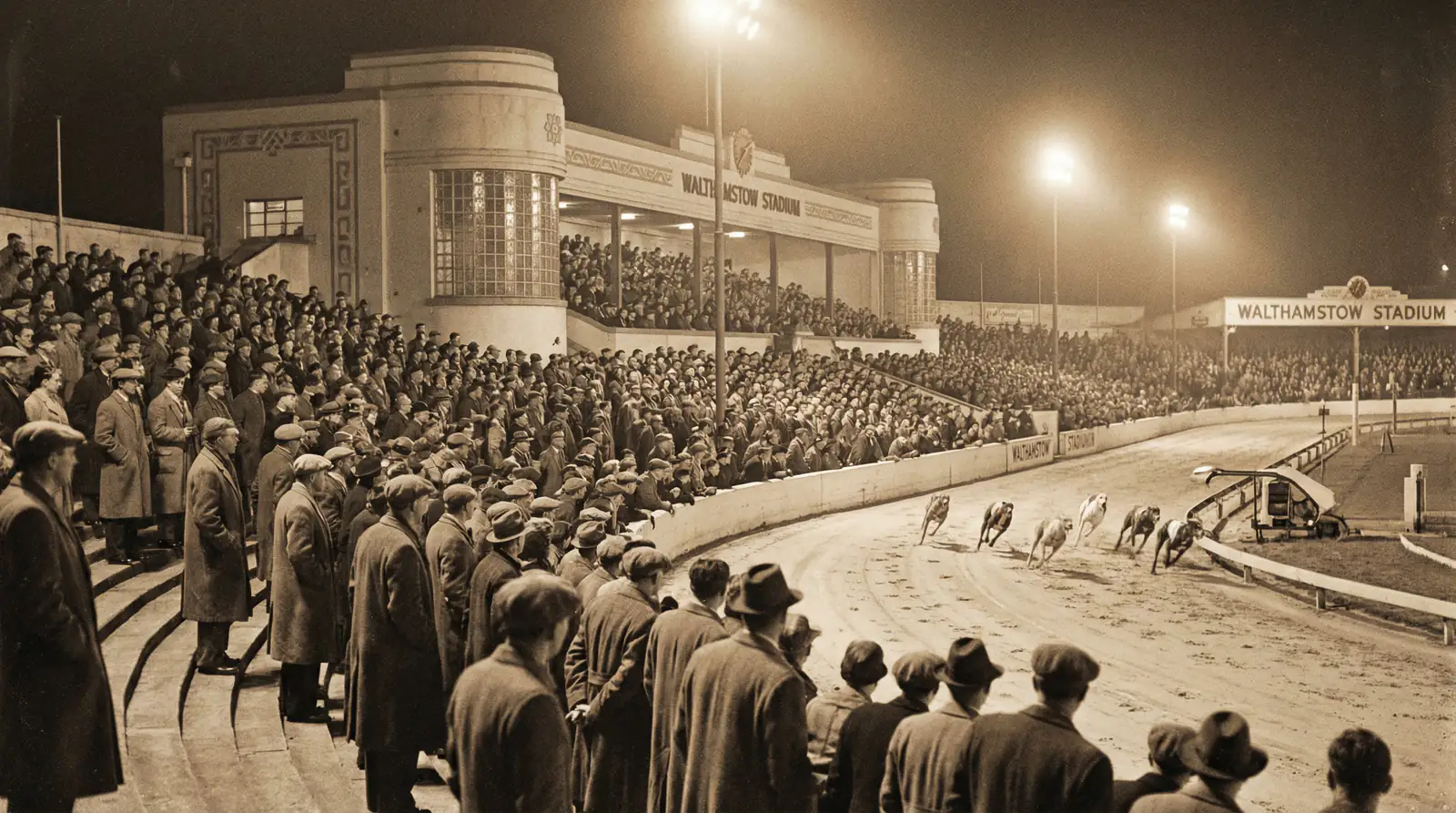
A Hundred Years of Chasing
Greyhound racing in the United Kingdom has a history that stretches back almost a century, and that history mirrors the social and economic currents of the country that shaped it. What began as a novelty spectacle in 1920s Manchester became the second-largest spectator sport in post-war Britain, drew crowds that rivalled top-flight football, sustained an entire ecosystem of breeding, training, and wagering, and then contracted sharply as leisure habits changed and urban land became too valuable for tracks to survive.
The sport that exists today is smaller, leaner, and structurally different from its mid-century peak. But it is not gone, and it is not static. Understanding where greyhound racing came from illuminates why it works the way it does now — why tracks are configured as they are, why the grading system operates on specific principles, why the betting infrastructure is so deeply integrated into the sport’s commercial model. The history is not decoration. It is the foundation beneath every racecard you open.
Belle Vue and the Birth of Track Racing
Organised greyhound racing in Britain began on 24 July 1926 at Belle Vue Stadium in Manchester. The event was the first meeting to use a mechanical hare — an electric lure running on a rail around the inside of an oval track — which replaced the older and rather less popular practice of coursing, where live hares were pursued across open ground. The mechanical hare was the invention that made track racing possible, and Belle Vue was where the concept was proved in front of a paying audience.
The response was immediate and overwhelming. The Belle Vue meeting attracted a crowd of around 1,700 — modest by later standards but substantial for an untested sport. Within weeks, the crowds grew. Within months, other promoters were planning their own tracks. The appeal was straightforward: greyhound racing was fast, accessible, held in the evening when workers were free, and offered regular betting opportunities at a time when legal off-course bookmaking was restricted. The combination of entertainment and wagering in a single evening package proved irresistible.
By the end of 1927, more than forty greyhound tracks had opened across England, Scotland, and Wales. The expansion was concentrated in urban industrial areas — London, Birmingham, Manchester, Glasgow, Liverpool — where large working-class populations provided both the audience and the economic base. Tracks were built on available land near public transport routes, often in inner-city locations that would later become valuable real estate. This geographical pattern planted the seeds of both the sport’s growth and its eventual contraction.
The early tracks varied wildly in quality. Some were well-financed operations with proper facilities, floodlighting, and permanent stands. Others were hastily assembled ventures with minimal infrastructure. The National Greyhound Racing Club, established in 1928, began the process of regulation — licensing tracks, registering dogs, and standardising rules — that would eventually produce the structured sport recognisable today. The NGRC became the governing body and maintained that role for decades before its functions were absorbed into the modern GBGB.
The Golden Age: Post-War Peak
Greyhound racing reached its zenith in the years following the Second World War. In 1946, total attendance at licensed tracks in Britain exceeded seventy million — a figure that placed greyhound racing behind only football as the nation’s most watched sport and comfortably ahead of horse racing, cricket, and rugby. The White City Stadium in London regularly drew crowds of fifty thousand or more for feature events, and the sport’s major competitions — the Greyhound Derby, the St Leger, the Oaks — were national sporting occasions covered by mainstream press.
The post-war boom was driven by several factors. Entertainment options were limited in an era before widespread television. Evening racing fitted around working hours in a way that Saturday afternoon football could not. The tote and on-course bookmakers provided legal betting in a period when off-course cash betting remained illegal, making the greyhound track one of the few places where a working man could have a wager without breaking the law. The social element was equally important — the stadium bar, the restaurant, the atmosphere of a shared evening out — and tracks invested in facilities that catered to this demand.
The quality of racing during this period was high. The breeding population was large, the competition for kennel places was fierce, and the best dogs became genuine sporting celebrities. Mick the Miller, who won the Derby in 1929 and 1930 and later starred in a feature film, had established the template for the greyhound racing star, and post-war champions continued to capture public imagination. The sport had cultural presence, commercial scale, and a depth of participation that supported hundreds of tracks across the country.
The tote — pool betting operated by the track — was central to the financial model. A percentage of every pool bet was retained by the track as revenue, funding prize money, facilities, and operations. On nights when attendance was high and the tote turnover was strong, tracks were profitable enterprises. The tote pool also provided a transparent pricing mechanism: the dividend was determined by the total pool and the number of winning tickets, which gave punters confidence that the betting was fair.
Decline, Closures, and the Changing Landscape
The contraction began in the 1960s and accelerated through subsequent decades. Television changed leisure habits. The legalisation of off-course betting shops in 1961 removed one of the greyhound track’s unique advantages — the ability to bet legally — and redirected wagering revenue away from the tote and towards the bookmaking industry. Car ownership increased, opening up alternative evening entertainment. The urban land on which many tracks stood became increasingly valuable for redevelopment, and track owners faced mounting pressure to sell to property developers.
The closures came in waves. Iconic venues disappeared one by one. White City, which had hosted the sport’s greatest nights, closed in 1984 and was demolished to make way for a media development. Wembley Stadium, Hackney Wick, Catford, Wimbledon, Hall Green — the roll call of lost tracks reads like a geography of twentieth-century British leisure. Each closure reduced the sport’s footprint, its audience, and its breeding and training infrastructure.
By the turn of the millennium, the number of licensed tracks had fallen from a post-war peak of around seventy to fewer than thirty. The crowds that remained were smaller and older. Prize money had not kept pace with inflation. The breeding population had contracted, and the pipeline of new dogs entering the sport had narrowed. The narrative of decline was well established, and the question for those within the sport was whether the trajectory could be arrested or merely managed.
The closures were not evenly distributed. Tracks in areas with high land values — London, especially — were the most vulnerable, because the economic return from redevelopment vastly exceeded the income from racing. Tracks in areas where land was cheaper, or where the track owned its freehold outright, had better survival prospects. This is why the current map of UK greyhound racing is weighted towards locations outside central London and in regional urban areas where the economic arithmetic is less hostile.
The Modern Era: Smaller, Commercial, Resilient
The greyhound racing that exists in the UK today is a fundamentally different enterprise from the post-war spectacle, but it is a functioning one. Around eighteen GBGB-licensed tracks operate across England, staging meetings every day of the week through the BAGS programme, RPGTV evening fixtures, and Premier meetings on Sky Sports Racing. The sport has restructured itself around media rights revenue and the bookmaker relationship rather than on-course attendance.
The commercial model now depends heavily on the income generated by selling broadcasting rights to bookmakers through SIS, RPGTV, and other distributors. This revenue funds prize money, track maintenance, and the operational costs of staging meetings. The model works because bookmakers need content — greyhound racing provides a continuous supply of short, frequent events that drive betting turnover — and the tracks need funding that declining attendance can no longer provide alone.
On-course attendance still matters at certain venues and for certain events. Premier meetings and major competitions attract crowds that, while modest by historical standards, sustain the live atmosphere that makes greyhound racing a spectator sport rather than a purely televised product. Some tracks have diversified into hospitality, offering restaurant and event packages that position a greyhound meeting as a social experience rather than purely a betting occasion.
The regulatory framework has modernised. The GBGB administers the sport’s rules, licensing, and welfare standards. Drug testing is routine. Welfare provisions for retired racing dogs have expanded significantly, driven by public pressure and the sport’s own recognition that long-term survival depends on demonstrating responsible treatment of the animals. Rehoming organisations — some operated by the sport itself, others by independent charities — now find homes for thousands of retired greyhounds each year.
A Century On: What the History Tells the Bettor
The history of greyhound racing is not merely a story about the past. It explains the present. The grading system evolved to produce competitive racing at a time when spectators demanded excitement — and it still does. The betting infrastructure was built around a sport that existed to facilitate wagering — and wagering remains the sport’s economic engine. The track layouts were designed in an era of rapid construction on available land — and the quirks of those layouts, the tight bends and short straights, produce the track biases that bettors exploit today.
The sport is smaller than it was. It is also more accessible to the individual bettor than it has ever been. Every meeting is streamed, every racecard is published online, every piece of form data is available digitally. The punter sitting at home with a laptop and a bookmaker account has more information at their disposal than the racegoer standing in the grandstand at White City in 1950 ever did. The scale has contracted. The opportunity has expanded. The dogs still run, the traps still open, and the first bend still decides the race. A hundred years in, the fundamentals have not changed at all.
Explore UK greyhound racing history on the livegreyhoundtoday homepage.
See the major events in the sport’s calendar in racing events.
