
Best Greyhound Betting Sites – Bet on Greyhounds in 2026
Loading...
Same Sport, Different Races
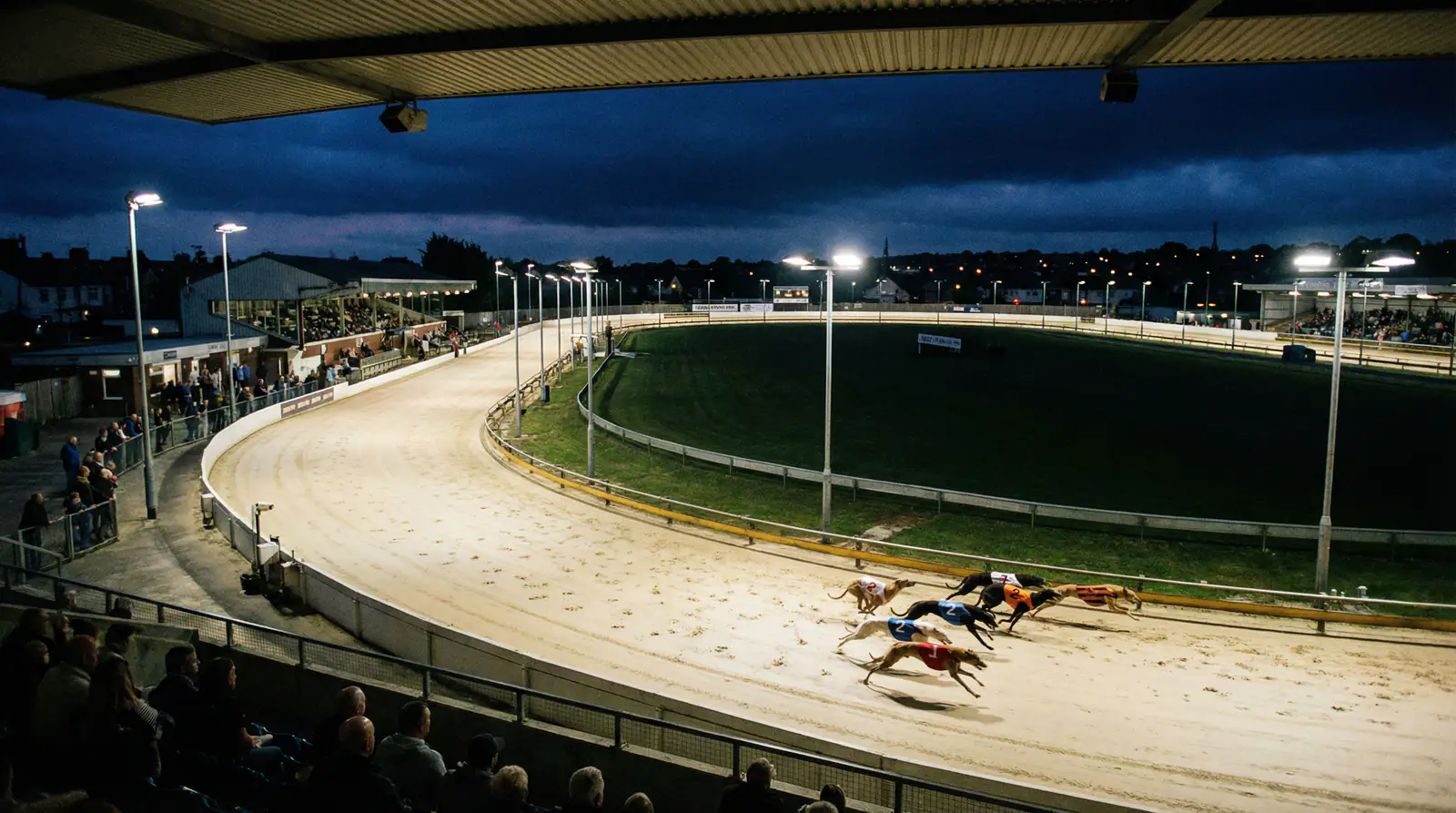
A greyhound sprinter and a greyhound stayer are built for different tasks. One races over two bends in a blur of acceleration that lasts barely fifteen seconds. The other sustains effort over six bends for half a minute or more, managing energy, navigating traffic, and holding pace through turns that test stamina as much as speed. Both are greyhound racing. The similarities end there.
UK greyhound tracks stage races at multiple distances, and each distance category produces a distinct form environment with its own characteristics, its own specialists, and its own betting dynamics. A dog that dominates over the sprint may be mediocre over the standard trip. A dog that plods through standard races may transform into a contender when the distance stretches. Understanding which distances exist, what each demands, and how to assess form across distance categories is fundamental to reading a racecard accurately.
The distances are not arbitrary. They are defined by track geometry — the number of bends the dogs must navigate determines the approximate distance, and each track’s circuit length produces slightly different trip measurements. What remains consistent across venues is the categorisation: sprint, standard, staying, and the rarer marathon and hurdle races that sit at the edges of the sport.
Sprint Races: Two Bends, Pure Speed
Sprint races are run over two bends, covering distances between approximately 260 and 285 metres depending on the track. These are the shortest races on the card and the most explosive. A sprint is over in fifteen to seventeen seconds, and the outcome is frequently decided in the first five.
The defining characteristic of sprint racing is the overwhelming importance of the trap break. In a race that lasts two bends, there is almost no time to recover from a slow start or a poor position at the first bend. The dog that breaks fastest and reaches the bend in front has covered a huge proportion of the race in clear air. The dogs behind have very little distance remaining to close the gap. Sprint win rates for first-bend leaders are even higher than in standard racing, often exceeding fifty percent at tight tracks.
Sprint specialists tend to be lighter, leaner dogs with explosive acceleration and quick reflexes from the traps. They do not need the stamina to sustain pace over a long distance — they need the ability to produce maximum speed almost instantly and maintain it for fifteen seconds. Their form profiles show consistently fast splits and QAw comments, and their career patterns often involve a narrow range of race distances.
For bettors, sprint races are the most draw-dependent events on the card. The shorter the race, the less room there is for class or fitness to override positional advantage. A moderate sprinter in trap one at a tight track is often a better bet than a faster sprinter in trap six, simply because the race does not provide enough distance for the faster dog to compensate for its wider starting position. The combination of split times and draw is the dominant analytical framework for sprints, more so than overall times or recent finishing positions.
The betting markets on sprint races tend to be tighter than standard races, partly because the fields are easier to assess — the fast-breaking, well-drawn runner is usually identifiable — and partly because the turnover on sprints is lower than on the standard trip. Forecast and tricast dividends in sprints can be modest because the first two or three places are often filled by the dogs the market expected. The value in sprint betting comes from identifying the races where the pace data points to a different outcome than the market expects, and these occasions are less frequent but more rewarding when they arise.
Standard Races: Four Bends, the Full Test
Standard races — four-bend contests over the track’s principal distance, typically between 450 and 500 metres — are the core of UK greyhound racing. The majority of races on any card are standard-distance events, and they form the division that most dogs are graded in and most punters are familiar with.
The standard trip tests a broader set of attributes than the sprint. Early pace still matters — the first bend advantage applies here as it does everywhere — but the additional two bends and the extra distance allow other qualities to emerge. Sustained pace, tactical awareness, the ability to handle crowding at multiple points in the race, and the stamina to maintain speed through the final straight all contribute to the outcome. A dog can afford a slightly slow start over the standard trip in a way that it cannot over the sprint, because there is more race remaining in which to recover.
Standard form is the most directly comparable across tracks and races. Because the majority of greyhounds race primarily at this distance, the grading system is most refined here, and the calculated times have the largest comparison pool. When you hear punters discuss a dog’s “class” or “level,” they are almost always referring to its standard-distance form.
The betting dynamics of standard races are the richest on the card. The fields are competitive, the grading is designed to produce close contests, and the variables — pace, draw, class, fitness, going — interact in complex ways. This complexity is what makes standard racing the most rewarding distance for form students. There are more angles to explore, more data to analyse, and more opportunities for the market to misprice a runner. The standard trip is where most greyhound betting profit is generated, and where the most persistent edges exist for punters who do their homework.
Staying Races: Six Bends, Stamina Rewarded
Staying races extend the contest to six bends, covering distances of approximately 630 metres and above. These are the endurance events of greyhound racing, and they produce a form environment that differs markedly from standard and sprint races.
The additional distance changes the relative importance of every variable. Early pace is still relevant — the first bend matters in every greyhound race — but its predictive power diminishes over six bends. A dog that leads at the first bend in a staying race must sustain that effort for twice as long as in a standard race, and many front-runners cannot. The energy expended in leading through four bends leaves them vulnerable to closers in the final two, and the strongest stayers are often those that sit just behind the pace before asserting in the closing stages.
Staying specialists are typically heavier, more powerful dogs with a longer stride and a deeper reserve of stamina. Their sprint times may be unremarkable, and their standard-distance form may look modest. Over six bends, they transform. The qualities that count at this distance — the ability to hold pace without tiring, the temperament to run relaxed through the early bends, the physical endurance to finish strongly — are not the same qualities that win sprints or even standard races.
The betting markets on staying races are often less well-formed than on standard races, because fewer punters specialise in the distance and the turnover is lower. This creates opportunities. A staying race with an obvious front-runner and two or three confirmed closers can produce a genuinely open market where the form student’s assessment carries more weight than the public money. Forecast and tricast dividends in staying races tend to be more generous than at shorter distances because the finishing order is less predictable and the market is less efficient.
Marathon and Hurdle Races: The Specialists’ Domain
Marathon distances — two full laps or longer, typically 840 metres and above — occupy a niche position in UK greyhound racing. Very few tracks stage marathon races regularly, and the dog population suited to these distances is small. The form pool is correspondingly thin, which makes assessment more difficult and the betting markets less reliable.
Dogs that excel at marathon distances are extreme stamina specialists. They run at a pace that would be pedestrian over shorter trips, but they sustain it for a duration that would exhaust a sprinter or standard-distance runner. Their form profiles often show consistent placings over staying distances with occasional wins when the field lacks a genuine stamina rival. The key to marathon betting is identifying which dogs have the physical endurance to last the distance and which will tire after six bends even if their staying form looks adequate.
Hurdle races add a different kind of specialisation. Dogs jump a series of low obstacles during the race, and the ability to clear hurdles cleanly — without losing momentum or stride pattern — is a skill that not every greyhound possesses. Some dogs take to hurdles naturally. Others lose their rhythm at every obstacle, disrupting their pace and costing lengths that they cannot recover.
Both marathon and hurdle races attract small but dedicated betting markets. The specialist nature of the events means the form is less well-known to casual punters, which can create value for those who track the niche form lines. However, the thin fields and infrequent scheduling also mean the sample sizes are small and the form is harder to assess with confidence. These are events for bettors who enjoy research and are comfortable with higher uncertainty.
Matching the Distance to the Decision
The practical lesson from distance analysis is that greyhound form is not transferable across categories without adjustment. A dog’s standard-distance form tells you something about its sprint potential and its staying ability, but it does not tell you everything. The qualities that produce success vary by distance, and the analytical framework you apply should vary accordingly.
For sprint races, prioritise splits, draw, and trap break consistency. For standard races, balance pace with class, fitness, and draw. For staying races, weight stamina and late pace more heavily and discount pure speed. For marathon and hurdle events, look for specific distance or obstacle experience and be cautious about extrapolating from form at shorter trips.
Most punters naturally gravitate towards the standard trip, and this is sensible — it produces the most racing, the deepest form, and the most betting opportunities. But ignoring the other distances means ignoring races where your analysis could carry even more weight precisely because fewer punters bother to study them. The sprint and staying markets are less efficient, the form is less well-understood by the public, and the edges for the prepared bettor are proportionally larger. Distance is not just a number on the racecard. It is a lens through which the entire race should be read.