Best Greyhound Betting Sites – Bet on Greyhounds in 2026
Loading...
Two Bets, One Slip
Each way is the safety net most greyhound bettors use first. It is also the bet most commonly misunderstood. The idea is straightforward — back a dog to win and hedge the risk by simultaneously backing it to place — but the mechanics, the cost, and the circumstances in which it makes sense all deserve more scrutiny than most punters give them.
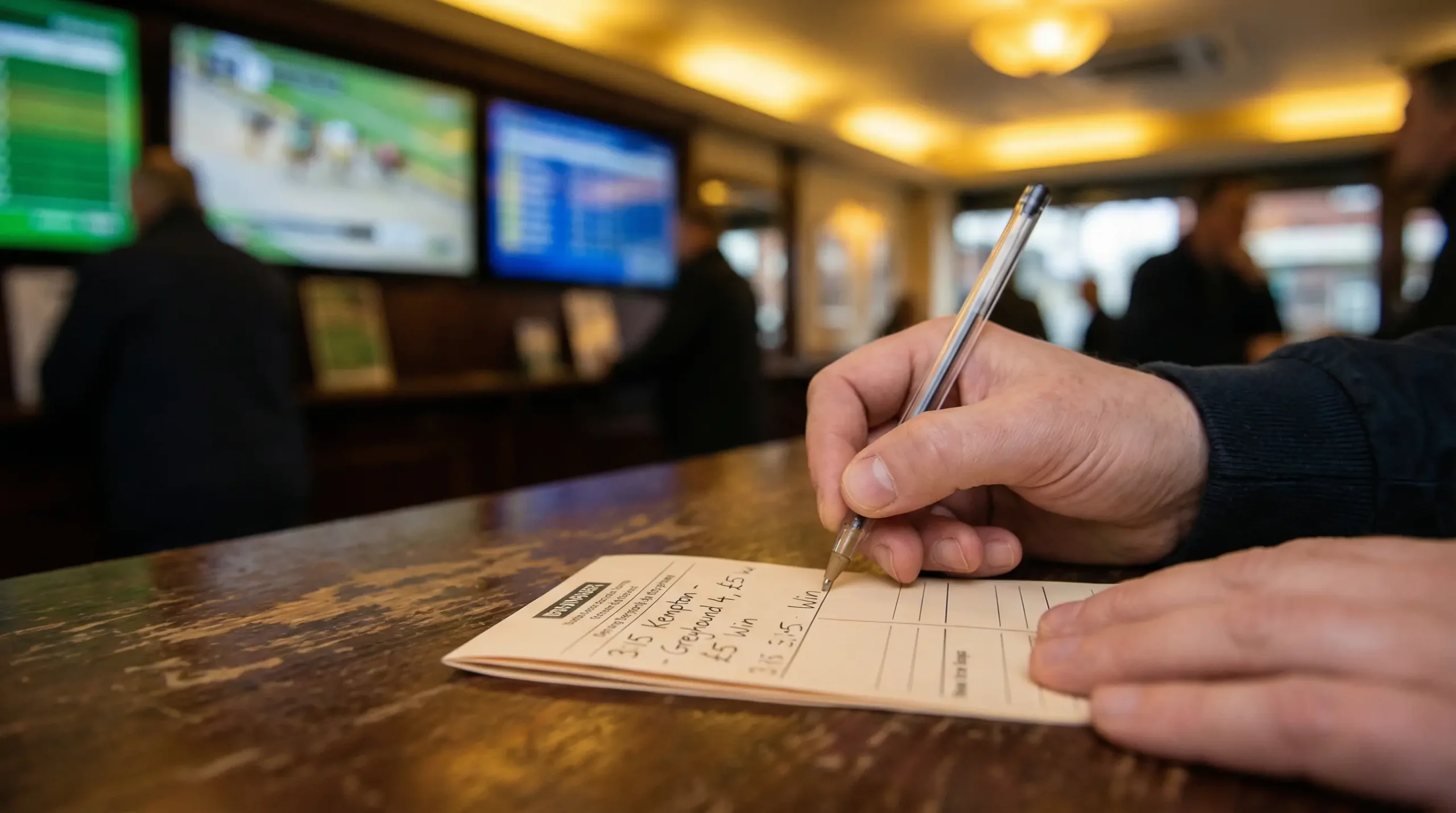
An each way bet is two bets. Not one. When you write five pounds each way on your betting slip, you are staking ten pounds in total. Five goes on the win, five goes on the place. If the dog wins, both bets pay. If the dog finishes second — the standard place position in UK greyhound racing — only the place bet pays. If the dog finishes third or worse, you lose both stakes.
This structure means each way is neither a conservative bet nor a reckless one. It is a bet with two distinct components, each of which has its own expected return. The discipline lies in assessing both components separately rather than treating the bet as a single, blurred wager. The win portion needs to justify itself at the win odds. The place portion needs to justify itself at the reduced place odds. If both check out, each way is a strong choice. If only one does, there may be a better option.
The popularity of each way in greyhound racing stems partly from the sport’s volatility. Six-dog fields generate frequent upsets, and a dog that you believe has a strong chance of finishing first or second is not a rare find. Each way feels like it captures that uncertainty. But feeling and mathematics do not always agree, and this guide works through the numbers to show when each way delivers real value and when it quietly erodes your bankroll.
How Each Way Works in Greyhound Racing
Your stake doubles. Your options broaden. That is the compact version. The expanded version requires you to follow two parallel calculations, one for each component of the bet.
The win portion operates exactly like a standard win bet. You back a dog at the displayed odds — say 7/1 — and if that dog wins, you receive your stake multiplied by those odds, plus your stake back. A five pound win at 7/1 returns forty pounds total: thirty-five in profit, five in returned stake.
The place portion operates at a fraction of the win odds. In UK greyhound racing, the standard place terms are one quarter of the win odds, paying on the first two finishers. At 7/1, the place fraction is 7/4. If your dog finishes first or second, the place part pays five pounds at 7/4, returning 13.75 in total: 8.75 in profit and 5 in returned stake.
The combined returns depend on the outcome. If the dog wins, you collect both the win return and the place return. At 7/1 each way with a five pound unit, a win returns 40 (win portion) plus 13.75 (place portion), totalling 53.75 from a ten pound total outlay. That is a net profit of 43.75. If the dog finishes second, you lose the five pound win stake but collect 13.75 from the place portion, giving you a net profit of 3.75 from your ten pound total bet.
If the dog finishes third or lower, both bets lose. You are down the full ten pounds. This is the critical detail. Each way does not protect you from a bad run. It only protects you from the narrow scenario where your selection runs well enough for second but not well enough for first. In a six-runner field, that is one specific finishing position out of five possible losing positions.
Let us extend the arithmetic across a range of odds to see where the returns sit. At 4/1 each way, a second-place finish returns 10 (place at 1/1 plus stake) from a 10 total bet — you break even. Below 4/1, a second-place finish generates a net loss. At 3/1 each way, the place portion pays 3/4 of the stake — returning 8.75 from a 10 outlay. You lose 1.25 even though the dog placed. At 2/1, the place return is just 7.50, costing you 2.50. The maths is unforgiving at short prices.
Conversely, at 10/1 each way, a second-place finish returns 17.50 (place at 5/2 plus stake) from a 10 total bet, yielding 7.50 profit. At 12/1, the place return of 20 gives you 10 profit from a 10 bet — a 100 per cent return on a dog that did not win. This is where each way starts to make serious mathematical sense.
Place Terms: 1/4 Odds, Top Two Only
Greyhound each way has narrower terms than horse racing — know them. In horse racing, place terms vary with field size. Races with eight or more runners typically pay three places, and handicaps with sixteen or more can pay four. Greyhound racing is simpler and tighter: six runners, two places, one quarter of the odds.
These terms are essentially fixed across all UK greyhound racing. Whether you bet on a graded A5 at Crayford or an open race at Monmore Green, the place terms are the same. There is no variation based on the quality of the race, the number of runners (it is always six unless there is a withdrawal), or the track. One quarter of the odds, first two finishers.
The narrowness of greyhound place terms compared to horse racing is often overlooked by punters crossing over from the horses. In a twelve-runner handicap at Cheltenham, each way at one fifth of the odds paying three places is a generous proposition. In a six-runner greyhound race at one quarter paying two places, the margin is much thinner. You need to beat four of five rivals just to collect the place portion, and the reduced fraction means the place return is smaller relative to the win odds.
This does not make greyhound each way a bad bet. It makes it a bet that needs to be used selectively. The place portion has to justify its stake independently, and at greyhound place terms, it only does so above a certain odds threshold. Below that threshold, you are paying for insurance that does not adequately cover the loss.
One additional consideration: some bookmakers occasionally enhance place terms for specific greyhound meetings, paying three places instead of two or offering one third of the odds instead of one quarter. These promotions are worth seeking out, because they meaningfully shift the each way arithmetic in the bettor’s favour. When the standard two-place, one-quarter terms feel too tight, an enhanced promotion can make each way viable at shorter prices than it would normally support.
When Each Way Offers Value
Not every race suits an each way bet. The most common mistake is defaulting to each way as a general-purpose hedge, backing every selection each way out of habit rather than calculation. Each way has specific conditions under which it generates positive expected value, and outside those conditions it is a drag on your returns.
The first condition is odds. As the arithmetic demonstrates, each way only produces a profit on a placed second at odds of approximately 4/1 and above, and only produces a meaningful profit at 6/1 and above. Below 4/1, each way guarantees a loss on a placed second, which defeats the purpose of the hedge. The practical rule: do not bet each way below 5/1 unless there is a specific promotional enhancement on the place terms.
The second condition is your assessment of the dog’s chance. Each way suits situations where you believe a dog has a realistic chance of winning but also a strong chance of finishing second if it does not win. This typically means a dog with good early pace that might lead to the first bend but faces one rival of comparable speed. If the dog beats that rival, it wins. If it does not, it likely finishes second. That competitive profile — contention but not certainty — is the sweet spot for each way.
Each way is less suited to dogs that are all or nothing. A railer with brilliant early pace from trap one will either ping the lids and lead all the way, or get crowded and finish out of the places entirely. There is no middle ground, and the place portion of the each way bet does not protect you because the dog’s finishing pattern does not produce regular second-place finishes. For these dogs, a straight win bet is more efficient.
Competitive open races at mid-range odds are the natural habitat for each way betting. Fields where three or four dogs have a genuine claim, the form is tight, and the odds reflect that uncertainty. In these races, backing a dog at 7/1 or 8/1 each way can be justified because the probability of a first- or second-place finish is genuinely higher than the odds imply. The each way bet captures the full range of positive outcomes from a single selection.
The Net Return: When Protection Costs More Than It Saves
Each way isn’t always safer — sometimes it just dilutes the edge. This is the uncomfortable truth that every each way enthusiast needs to face at some point: the place portion of an each way bet is an insurance policy, and like all insurance, it has a cost.
The cost is your doubled stake. Every time you bet each way, you commit twice the money you would have committed to a straight win bet. If you had ten pounds to bet on a race, a win bet puts all ten on the nose. An each way bet at the same unit stake puts five on the win and five on the place. Your win portion is now half the size, which means your profit from a winner is half what it would have been with a straight win bet at the same total outlay.
Consider a concrete comparison. You have ten pounds to bet on a dog at 8/1. Option one: ten pounds to win. If the dog wins, you return 90 (80 profit plus 10 stake). If it finishes second, you lose 10. Option two: five pounds each way (10 total). If the dog wins, you return 53.75 (win return plus place return). If it finishes second, you return 15 (place at 2/1 plus stake), netting 5 profit.
The second option provides a 5 profit on a second-place finish that the first option does not. But the first option provides 80 profit on a winner versus 43.75. The protection costs you 36.25 in potential profit every time the dog actually wins. Over the long run, the question is whether the frequency of second-place finishes generates enough cumulative profit to offset the reduced win returns. In most cases, the answer depends on the specific dog and the specific race, not on a blanket habit.
The sharpest approach to each way is to treat it as a tool, not a default. Calculate the returns on both components. Ask yourself whether the place portion is worth its stake at the reduced odds. If the answer is yes — because the odds are generous and the dog’s profile suits regular place finishes — bet each way with confidence. If the answer is no — because the odds are too short, the dog’s running style is too binary, or you are simply hedging out of nerves — put the money on the win and accept the risk. In greyhound racing, the bets that work best are the ones backed by arithmetic, not anxiety.