Greyhound Racing Odds Explained: Fractional, Decimal & SP
Understand greyhound racing odds — fractional vs decimal, how odds are set, starting price, market movements and calculating potential returns.
 Available in US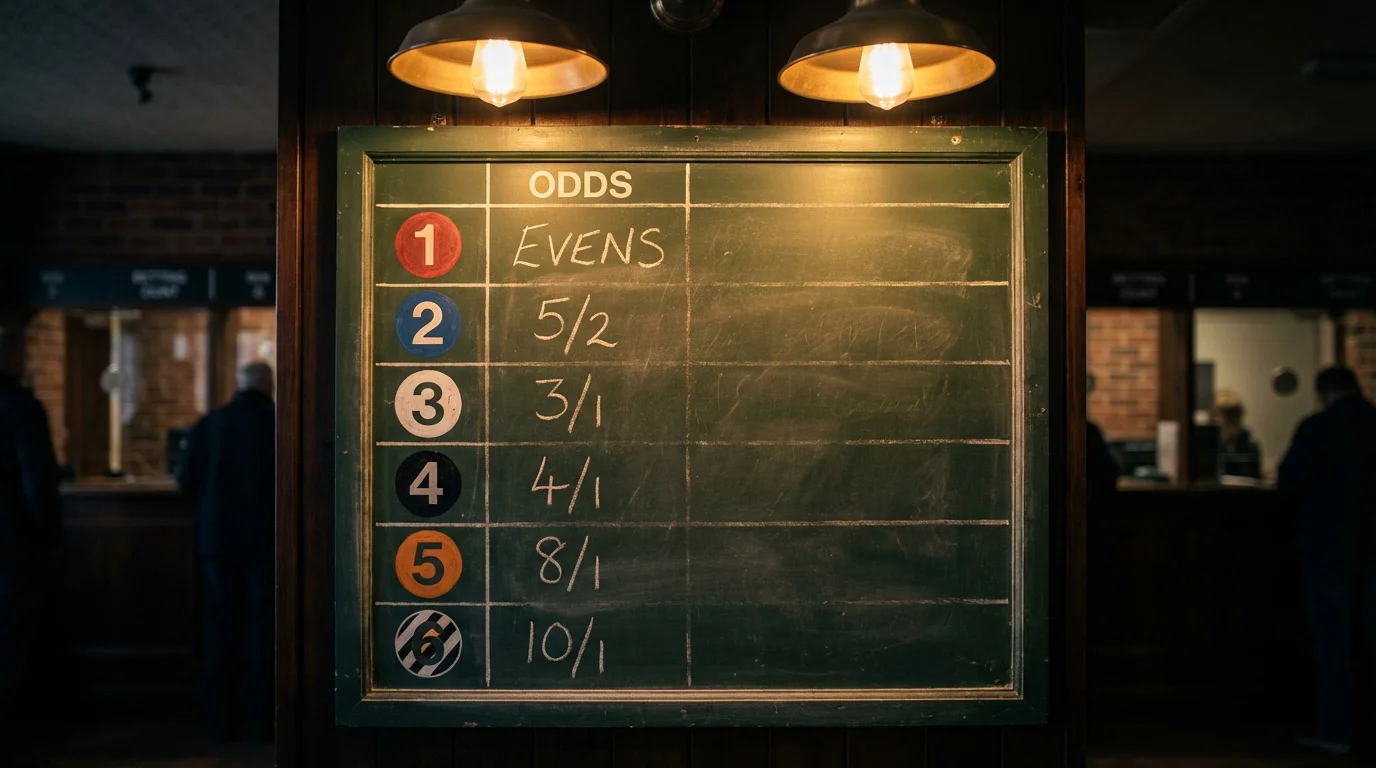
Odds Aren’t Predictions — They’re Prices
The odds don’t tell you who’ll win. They tell you what the market thinks. This distinction matters more than any technical detail about formats or calculations, because it shapes how you should read and use every price you see on a greyhound racecard.
When a bookmaker prices a greyhound at 3/1, they are not expressing a scientific assessment of that dog’s ability. They are setting a price that reflects a combination of their own tissue — the initial estimate of each dog’s chance — and the weight of money coming from punters. If lots of bettors back one dog, its price shortens. If a dog is ignored, its price drifts. The odds are a market mechanism, not a performance rating.
This is why greyhound odds can be simultaneously informative and misleading. They tell you where the money is going, which correlates loosely with where the expertise sits. But they also reflect herd behaviour, promotional activity by bookmakers, and the sheer randomness of which dogs catch the public’s eye on any given evening. A 2/1 favourite is not twice as likely to win as a 4/1 shot in any literal sense. It is simply the dog that the combined weight of market activity has settled at that price.
Understanding this principle changes how you approach the racecard. Instead of looking at odds as answers, you start treating them as questions. Is this dog really a 5/2 chance? Does the form support this price, or has the market overreacted to a recent win? The punters who consistently find value in greyhound racing are the ones who learned to interrogate the odds rather than accept them.
Fractional Odds: The UK Standard
3/1 means three to one — three pounds profit for every pound risked. That is the entire system. Fractional odds express the ratio of profit to stake, and they are the dominant format in UK greyhound racing, displayed on racecards, in betting shops, and on bookmaker websites set to their default UK view.
The first number is the potential profit. The second is the stake required to earn that profit. At 5/1, a one pound bet returns five pounds profit plus the original stake, for a total of six pounds. At 7/2, a two pound bet returns seven pounds profit, or proportionally a one pound bet returns three pounds fifty in profit plus the stake.
Where fractional odds occasionally confuse newer bettors is in the less intuitive fractions. Odds of 11/8, 100/30, or 6/4 all describe the same relationship — profit relative to stake — but they require a moment of mental arithmetic that 3/1 or 5/1 do not. The solution is straightforward: divide the first number by the second. 11/8 equals 1.375, meaning every pound staked returns one pound thirty-seven in profit. 6/4 simplifies to 3/2, which is the same as 1.5 to 1.
Odds-on prices — where the first number is smaller than the second — indicate a dog the market considers more likely to win than not. At 4/6, you risk six pounds to win four. The total return on a six pound bet is ten pounds, but four of that is profit. Odds-on favourites in greyhound racing are common in weaker graded races, where one dog clearly outclasses the field on recent form. Whether backing odds-on in greyhound racing is sensible depends entirely on how reliable you believe that form advantage to be in a sport where one stumble at the first bend can undo everything.
Evens, or 1/1, is the pivot point. A one pound bet returns one pound profit. The implied probability of a dog at evens is 50 per cent before the bookmaker’s margin is factored in. In a six-runner race, that suggests a dog with a much stronger chance than an average field share of roughly 17 per cent.
Decimal Odds and Why They Matter
Decimal odds present the same information in a different wrapper. Instead of separating profit from stake, decimal odds show the total return per unit staked. Fractional odds of 3/1 become 4.0 in decimal. The difference of one is your original stake.
The conversion is simple. Take the fractional odds, divide the first number by the second, and add one. 5/1 becomes 6.0. 7/2 becomes 4.5. 11/8 becomes 2.375. Evens is 2.0. Any decimal odds below 2.0 are odds-on.
Decimal odds are the standard format on betting exchanges and are increasingly common on bookmaker platforms, particularly for customers who also bet on European football or other international sports. They are objectively easier to calculate with, especially when comparing prices across multiple selections or working out accumulator returns. Multiplying three decimal odds together gives the exact combined decimal odds of a treble. Try doing that with 11/4, 7/2 and 100/30 in fractional format and the advantage becomes clear.
For greyhound racing specifically, most UK bettors will encounter fractional odds by default. But if you are placing bets online or using a betting exchange for greyhound markets, switching your display to decimal is a practical move. It removes the need to convert awkward fractions and lets you compare prices across bookmakers more quickly. The underlying maths is identical. The format is simply more transparent.
Starting Price and Best Odds Guaranteed
Take the price or wait for SP? BOG makes the question irrelevant. But before explaining why, it helps to understand what the starting price actually is and how it operates in greyhound racing.
The starting price — SP — is the final price of a greyhound at the moment the traps open. It is determined by the on-course market, reflecting the aggregate of bets placed at the track or fed into the live betting ring. When you select SP on your betting slip rather than taking a fixed price, you are accepting whatever odds the dog starts the race at. Those odds might be better or worse than the price available when you placed the bet.
In greyhound racing, early prices are typically published on the morning of the meeting, with some bookmakers offering prices from as early as 8am for evening cards. These early prices can shift significantly throughout the day as money comes in. A dog priced at 4/1 in the morning might start at 5/2 if it attracts heavy support, or drift to 6/1 if the market moves away from it.
This creates a dilemma. Take the early price and lock in known odds, or wait for SP and hope the price improves? Best Odds Guaranteed — commonly abbreviated to BOG — eliminates this dilemma entirely. With BOG, the bookmaker guarantees you the higher of the price you took and the starting price. If you back a dog at 4/1 in the morning and it starts at 6/1, you are paid at 6/1. If it starts at 3/1, you keep your 4/1. You cannot lose on the price comparison.
Most major UK bookmakers offer BOG on greyhound racing, though the terms vary. Some apply it to all UK races, others only to RPGTV or featured meetings. Check the specific terms before assuming it is active on every race. Where BOG is available, there is very little reason to select SP. Take the early price and let the guarantee handle the rest.
How and Why Odds Move
Money talks — watch where the market moves. Greyhound odds are not static. From the moment early prices are published to the instant the traps open, the odds on every runner in the field are subject to change. Understanding why prices move gives you a significant informational advantage.
The primary driver of odds movement is money. When punters back a specific dog in volume, the bookmaker shortens that dog’s price to limit their liability. Simultaneously, the prices on the other five runners may lengthen to rebalance the book. This is the basic mechanism of a moving market.
In greyhound racing, significant market moves often reflect insider knowledge — or at least knowledge from people closer to the kennels and tracks than the average punter. A dog returning from a rest period, or one that trialled well privately, might attract sharp money before the public catches on. Watching for sudden, sustained price contractions on a specific runner — particularly one that has not been running recently — can be a worthwhile exercise. It does not guarantee that dog will win, but it tells you that someone with money and conviction believes it has a strong chance.
Conversely, a dog whose price drifts steadily from 3/1 to 5/1 without any obvious change in circumstances may be suffering from a lack of support, which itself can be informative. If the market does not fancy a graded favourite, there might be something in the wind — a track switch it dislikes, a wide draw it cannot overcome, or a known issue that the racecard does not capture.
The speed of greyhound market movements is faster than in horse racing. With races going off every few minutes, the window between early prices and SP is compressed. If you want to read the market, you need to be watching the prices in the thirty to sixty minutes before race time, not just glancing at the card at the last moment.
Odds Are the Start — Value Is the Goal
A short price isn’t bad. A short price on the wrong dog is. The concept of value is the thread that connects every section of this guide, and it deserves a final, focused statement.
Value in betting has a precise meaning: it exists when the odds offered on an outcome are greater than the true probability of that outcome occurring. If you believe a dog has a 33 per cent chance of winning — roughly a 2/1 chance — and the bookmaker is offering 4/1, you have found value. You will not win every time you back that dog, but over a sustained number of bets at value prices, the maths works in your favour.
Finding value requires you to form your own assessment of a greyhound’s winning chance before looking at the odds. This is where the form, the draw, the pace analysis, and the track knowledge come together. You build a view of the race, estimate which dog or dogs have the strongest claims, and then compare your estimate to the market. If the market agrees with you, there is no edge. If the market disagrees — and you have sound reasons for your view — the edge may sit with you.
Most greyhound bettors work the other way round. They look at the odds first, pick the dog they like at the price they find attractive, and justify the selection afterwards. This is not analysis. It is shopping. The prices on a racecard are the start of the conversation, not the conclusion. Your job is to decide whether the price is right, not simply whether the dog can win. Every dog in the field can win. The question is always whether the price compensates you fairly for the risk.
Understand greyhound racing odds on the livegreyhoundtoday homepage.
Find the best odds available in best odds.
