
Tote Greyhound Betting: Pool Wagering & Jackpot Bets
How tote and pool betting works at greyhound racing — jackpot pools, exacta, trifecta and placepot explained, plus how payouts are calculated.
 Available in US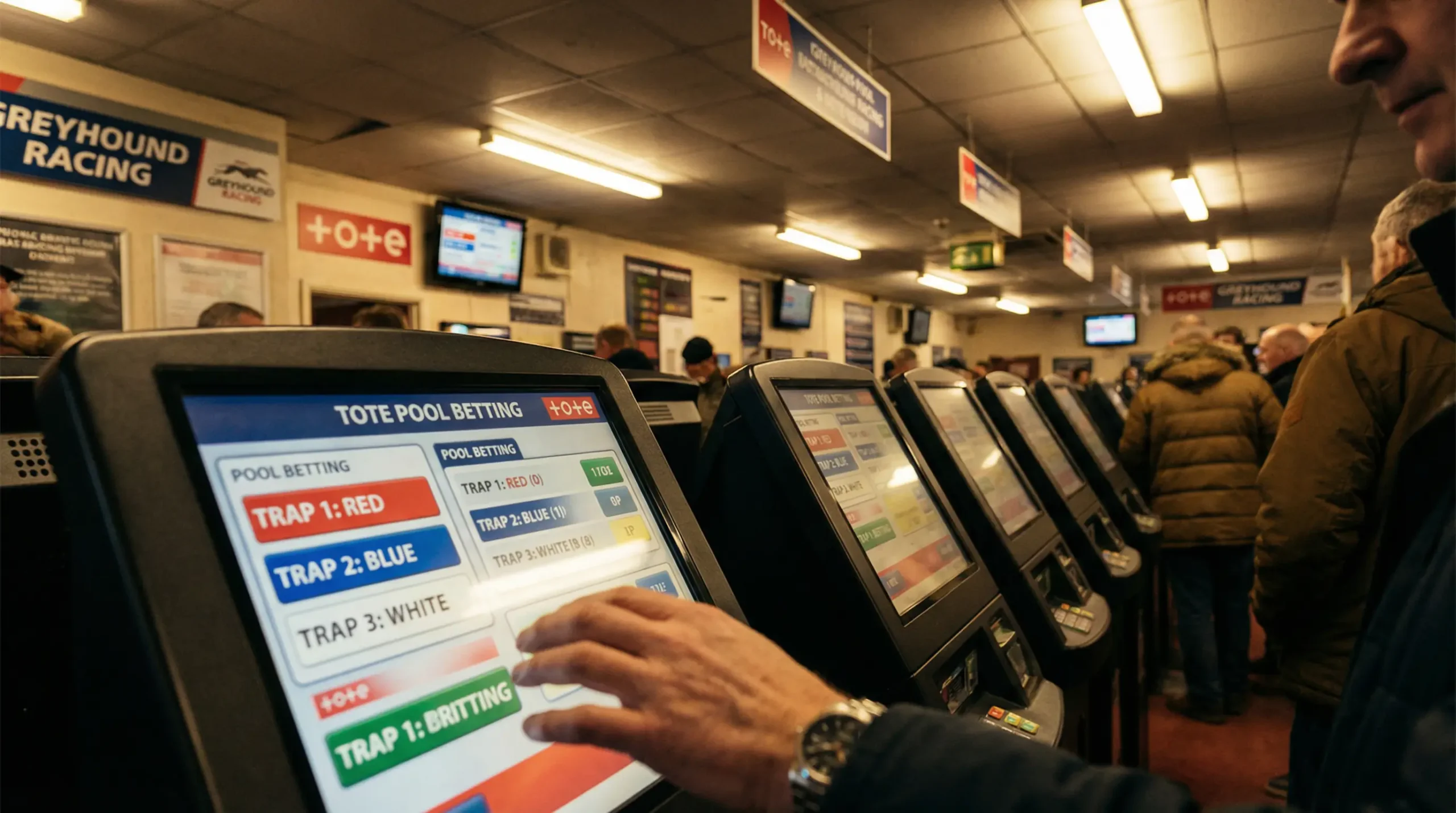
A Different Way to Bet on the Same Race
Most greyhound bets in the UK are placed at fixed odds with a bookmaker. You take a price, the dog wins or loses, and your return is determined by the odds you accepted at the time of the bet. This is the dominant model, and it is the one that every other article on this site assumes. But it is not the only model. Pool betting — betting into a shared pot whose total is divided among the winners — has been part of greyhound racing since the sport began, and it operates on fundamentally different mechanics that create a different kind of betting proposition.
The tote is the on-course pool betting system operated at UK greyhound tracks. It collects stakes from all bettors on a given race into a pool, deducts a percentage for the operator, and distributes the remainder to the winning tickets. The payout is not known until after the race, because it depends on the total pool size and the number of winning bets. This uncertainty is the defining characteristic of pool betting and the feature that makes it both more and less attractive than fixed-odds betting depending on the circumstances.
Understanding how pool betting works, what the different pool types offer, and when the tote represents better value than the bookmaker is a straightforward addition to your greyhound betting toolkit.
How Pool Betting Works
The mechanics of pool betting are simple in principle. Every bet on a specific race and pool type is aggregated into a single fund. After the race, the operator deducts a commission — typically between fifteen and thirty percent depending on the pool type and the operator — and the remaining fund is divided equally among the winning units.
If the win pool on a race collects one thousand pounds and the operator deducts twenty percent, eight hundred pounds remains for distribution. If the winning dog attracted two hundred pounds of that total pool, the win dividend is eight hundred divided by two hundred, which equals four. A one pound winning ticket returns four pounds. This is expressed as a tote dividend — typically displayed as the return to a one pound or two pound stake — and announced after the race along with the official result.
The critical difference from fixed-odds betting is that the return is determined by the behaviour of other bettors. If a dog is heavily backed in the pool, the dividend is compressed — more winning tickets share the same pot. If a dog is lightly backed, the dividend is inflated. This creates a dynamic where popular selections pay less on the tote than they do at fixed odds, and unpopular selections may pay considerably more.
This dynamic is the source of both the opportunity and the risk in pool betting. When the crowd piles onto the favourite, the tote dividend on the favourite shrinks, sometimes below the bookmaker’s starting price. But the pool money has to go somewhere, and it inflates the dividend on every other runner. A 5/1 shot with the bookmaker might pay the equivalent of 8/1 on the tote simply because the pool money was disproportionately concentrated on the favourite. The reverse also applies: a popular each-way selection can see its tote place dividend compressed below the bookmaker equivalent.
Jackpot and Pick Bets
Beyond the standard win and place pools, the tote and online pool operators offer jackpot-style bets that require picking winners across multiple consecutive races. These multi-leg pools produce the largest single payouts in greyhound betting — potentially thousands of pounds from a modest stake — and they operate on the same pooled-stake principle as single-race bets.
The Jackpot typically requires selecting the winner of six consecutive races. All stakes are pooled, and only bettors who correctly nominate all six winners share the payout. If nobody selects all six, the pool usually rolls over to the next meeting, creating a growing jackpot that attracts more entries and larger pools. The difficulty of naming six consecutive greyhound winners is substantial — the probability, even with informed selections, is extremely low — and the Jackpot is better understood as a low-cost, high-variance entertainment bet than as a serious profit-making strategy.
The Placepot operates on a similar multi-race format but requires your selection to finish in the first two in each nominated race rather than winning outright. The lower bar for success means the Placepot is hit more frequently than the Jackpot, and the dividends are correspondingly smaller. However, the Placepot is more accessible to form-based bettors because placing in the first two is a more forecastable outcome than winning, and a run of sensible each-way selections can produce a Placepot return.
The Scoop6 and other promotional pools appear periodically and follow similar mechanics with their own entry conditions and prize structures. The specific products available vary by operator and by meeting, and it is worth checking the pool menu before the meeting starts to see which options are available. Some pools are only offered at selected tracks or on specific days, and missing a favourable pool because you did not check the schedule is an easily avoidable mistake.
Perming — selecting multiple dogs in one or more legs of a multi-race pool — increases your coverage but multiplies the cost. A Jackpot perm with two selections in each of six legs produces sixty-four combinations (two to the power of six), each costing the minimum stake. At a one pound minimum, a full perm costs sixty-four pounds. The cost escalates rapidly with additional selections per leg. Three selections per leg across six races produces 729 combinations. Calculate the total cost before committing to a perm, and compare it to the likely pool size and expected dividend to assess whether the outlay is proportionate.
Exacta and Trifecta Pools
Exacta and Trifecta pools are the pool-betting equivalents of fixed-odds forecasts and tricasts. An Exacta requires naming the first two finishers in exact order. A Trifecta requires the first three in exact order. The stakes are pooled, and the dividend is shared among correct tickets after the operator’s deduction.
The Exacta pool is directly comparable to a bookmaker straight forecast, and the same analytical approach applies: identify two dogs likely to dominate the race and predict their finishing order. The difference is the payout mechanism. A bookmaker forecast pays a computer-calculated dividend based on the starting prices. A pool Exacta pays based on the pool size and the number of correct tickets. When the correct result is a combination that few other bettors selected — for example, two outsiders finishing first and second — the Exacta dividend can significantly exceed the bookmaker forecast payout.
Trifecta pools amplify this effect. Naming the first three in order is difficult enough that correct tickets are often rare, and the dividends can be dramatically large. A Trifecta involving three mid-priced or longer-priced runners can produce a payout that dwarfs the equivalent computer tricast, simply because so few bettors selected that precise combination in the pool. These outsized payouts are the pool system at its most rewarding, and they occur more frequently than most punters expect — especially on competitive cards where no obvious favourite dominates.
Combination Exactas and Trifectas work the same way as combination forecasts and tricasts: you select multiple dogs and cover all permutations at a cost of one unit per permutation. The maths is identical — three dogs in a combination Trifecta produces six permutations, four dogs produces twenty-four — and the same cost-awareness applies. The dividend, when it lands, is applied to one winning permutation, so the net profit is the dividend minus the total cost of all permutations.
How Tote Dividends Are Calculated
The tote dividend on any pool is a function of three variables: the total pool size, the operator’s deduction, and the amount staked on the winning outcome. The formula is: dividend per unit equals the net pool (total pool minus deduction) divided by the total amount staked on the winning selection.
The operator’s deduction varies by pool type. Win pools typically carry a deduction of around fifteen to twenty percent. Place pools are similar. Forecast, Trifecta, and Jackpot pools carry higher deductions — sometimes twenty-five to thirty percent — reflecting the larger payouts and the operator’s increased risk management costs. These deductions are the pool operator’s equivalent of the bookmaker’s overround, and they represent the structural cost of participating in pool betting.
The deduction means that pool betting is not a zero-sum game between bettors. It is a negative-sum game in which every pound staked is reduced by the deduction before any winnings are distributed. Over time, the aggregate return to all pool bettors is the total staked minus the total deducted. Individual bettors can beat this average — by consistently selecting outcomes that are under-backed relative to their true probability — but the average bettor loses the deduction percentage over time.
Pool dividends are announced as a return to a standard unit stake — usually one pound or two pounds depending on the operator. A win dividend displayed as “£4.60” means a one pound winning ticket returns four pounds sixty, of which three pounds sixty is profit. Dividends include the returned stake, which differs from how fixed-odds returns are sometimes quoted. When comparing a tote dividend to a bookmaker price, remember that a 4/1 bookmaker win returns five pounds (four profit plus stake), equivalent to a tote dividend of £5.00.
The Pool Angle: When Tote Beats the Bookmaker
Pool betting beats fixed-odds betting in specific, identifiable situations. The common thread is a distortion in the pool caused by disproportionate public money on one or two runners, which inflates the dividend on every other dog.
When a race has a short-priced favourite that attracts the majority of the pool money, the tote win dividend on that favourite will be lower than the bookmaker’s SP. But the dividends on the other runners — particularly those in the 4/1 to 10/1 range — will often exceed their bookmaker equivalents. If your selection is not the favourite, checking the tote pool distribution before the race can reveal whether the pool offers a better payout than the fixed-odds market.
Exacta and Trifecta pools offer the most dramatic tote advantages. Because the number of possible permutations is large and the concentration of pool money is heavily skewed towards obvious combinations (favourite first, second favourite second), unusual results produce dividends that can be multiples of the equivalent bookmaker computer forecast. The pool rewards contrarian selections — backing outcomes that few other people backed — which aligns naturally with the form-based bettor who spots an angle the public has missed.
The tote is not always better. When your selection is the obvious favourite, the bookmaker will almost certainly offer a better return. When the pool is small — as it often is at poorly attended BAGS meetings — the dividends can be volatile and unpredictable. Pool betting works best at well-attended meetings with large pools and heavy public concentration on one or two runners. Know the conditions, check the pool, and take the better price wherever it appears.
Explore tote and pool betting on the livegreyhoundtoday homepage.
Compare tote with standard bet types in bet types.
