
Greyhound Track Conditions: How Going Affects Race Times
How track conditions affect greyhound racing — going allowances, sand track surfaces, rain impact, calculated times, and adjusting your bets for going.
 Available in US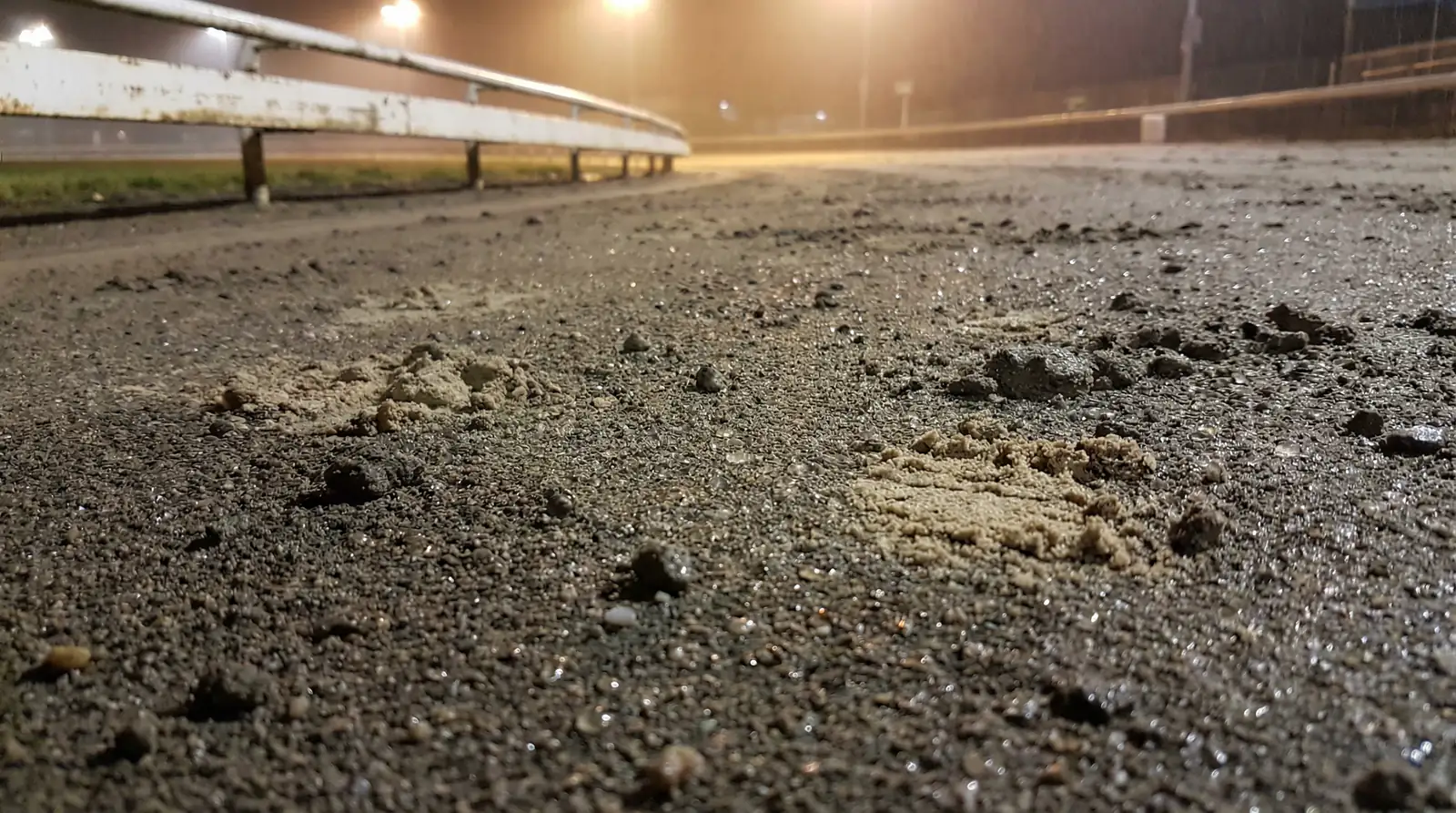
The Surface Nobody Talks About
Greyhound racing takes place on sand. Not turf, not dirt, not synthetic all-weather — sand. Every GBGB-licensed track in the UK uses a sand-based surface, and the condition of that surface on any given night directly affects the speed, effort, and relative performance of every dog in every race. In horse racing, the going is a headline item — good to firm, soft, heavy — discussed by pundits, weighed by bettors, and printed in bold on the racecard. In greyhound racing, the going is equally influential but receives a fraction of the attention.
This imbalance creates opportunity. The going in greyhound racing is measurable, published, and consistent enough in its effects that any bettor willing to incorporate it into their analysis gains an advantage over the majority who do not. The surface changes from meeting to meeting. The dogs respond to those changes in predictable ways. The racecard provides the data to account for both. The only missing ingredient is the habit of looking.
Understanding how sand surfaces behave, what going allowances mean, and how weather conditions alter the track transforms time-based form analysis from approximate to precise. It is the difference between comparing numbers and comparing performances.
Sand Surfaces: How They Behave
The sand used on UK greyhound tracks is not uniform beach sand. It is a graded, engineered surface designed to provide consistent grip, drainage, and cushioning. Tracks maintain their surfaces through regular grading — mechanical levelling and redistribution of the sand to ensure evenness — and through moisture management, adding water in dry conditions to prevent the surface becoming too loose and allowing natural drainage after rain.
The physical properties of sand change with moisture content. Dry sand is loose and deep. Dogs running on a dry surface sink fractionally further with each stride, which increases the energy cost per step and slows overall times. Damp sand firms up, providing a harder surface with better grip and less give. Dogs running on damp sand produce faster times because each stride returns more energy and the surface resists foot strike less. Wet sand — saturated by heavy rain — becomes heavy and clinging, slowing times again as the dogs work harder to pull their feet through the waterlogged surface.
The optimal running surface is moderately damp: firm enough to provide good traction but not so dry that the dogs labour through loose material, and not so wet that the surface becomes heavy. Tracks aim for this middle ground through their maintenance schedules, watering the sand before meetings in dry weather and relying on drainage systems after rain. The degree to which they achieve it varies by night, by season, and by the weather conditions between maintenance sessions.
Different areas of the same track can run at different speeds. The inside rail, where most racing traffic runs, can become more compacted than the middle and outside of the track. Bends may have different surface characteristics from straights because of how the sand redistributes under centrifugal force. These micro-variations are difficult to quantify but are visible to observant punters who watch races closely. A dog running wide through the bends may be on a different surface from the one hugging the rail, and the time difference is not solely attributable to the extra distance travelled.
Going Allowances: The Adjustment System
Every greyhound meeting carries a going allowance — a numerical figure that quantifies how fast or slow the track is running relative to its standard. The going is expressed in spots, where one spot equals one hundredth of a second. A going allowance of minus ten means the track is running ten spots (0.10 seconds) slower than its standard pace. A going allowance of plus five means it is running five spots faster.
The going is calculated by the racing office at each track using reference times. Before or during the meeting, the track’s running speed is assessed against the expected standard for that venue, and the allowance is set accordingly. The figure is published on the racecard and applied to finishing times to produce calculated times — the standardised figures that allow comparison across meetings.
The mechanism is straightforward. If a dog runs 29.80 on a night when the going is minus ten, its calculated time is 29.70 (the raw time adjusted by the going allowance). If the same dog runs 29.60 on a night when the going is plus five, its calculated time is 29.65. The calculated time strips out the surface effect, leaving a figure that reflects the dog’s performance independent of the track conditions on the night.
Going allowances vary widely. A fast summer evening on a well-maintained track might produce a going of plus ten or more. A rain-soaked winter card might carry a going of minus fifteen or minus twenty. The range across a season can span thirty spots or more at a single venue, which translates to a difference of 0.30 seconds in raw finishing times between the fastest and slowest surfaces. In a sport where the margin between first and second is frequently less than a length — roughly 0.08 seconds — a thirty-spot going variation is enormous.
Not all tracks publish their going allowance with the same prominence. Some display it clearly on the racecard and on the track’s website. Others require you to check the Racing Post or a specialist data provider. The information is always available if you look for it, but it is not always presented in a way that encourages casual punters to factor it in. This asymmetry is part of the edge.
Rain, Wind, and What Weather Does to Racing
Rain is the most significant weather variable in greyhound racing. Light rain during a meeting can change the going by several spots between the first and last race on the card. Heavy rain can shift the going dramatically within the space of two or three races. A card that starts at a going of minus five might finish at minus fifteen if a sustained downpour arrives mid-meeting.
The practical consequence is that form from the early races on a rain-affected card is not directly comparable to form from the later races, even though both carry the same published going figure. The going allowance is typically set at the start of the meeting and may not be updated during the card. If conditions deteriorate, the later races will run on a slower surface than the going suggests. Bettors who are watching the meeting live — or who check the raw times of earlier races against their calculated equivalents — can detect this mid-meeting shift and adjust their expectations for later races.
Wind has a smaller but measurable effect. A strong headwind on the home straight slows finishing times, while a tailwind can shave a spot or two. The effect is more noticeable at exposed tracks without significant surrounding structures than at enclosed urban venues. Wind is not accounted for in the published going allowance, which means raw times on windy nights may be slightly misleading even after the going adjustment is applied.
Temperature affects the sand indirectly through moisture evaporation. Hot summer afternoons dry the surface between the morning watering and the evening meeting, potentially leaving a looser track than the maintenance team intended. Cold winter nights do not freeze sand in the way they freeze turf, but the lower temperatures slow evaporation and keep the surface damper for longer. These seasonal patterns create a predictable rhythm in going figures: faster surfaces in mild, dry conditions and slower ones in wet, cold weather.
Adjusting Times: Doing It Properly
The calculated time on the racecard is the primary tool for going-adjusted comparison, and for most bettors most of the time, it is sufficient. The going adjustment has been applied by the racing office, and the resulting figure provides a reasonable basis for comparing a dog’s runs across different meetings.
Where the standard calculated time falls short is in races where the going changed during the meeting, in runs where the published going may not reflect the actual surface conditions for a specific race, and in comparisons between tracks where the going is measured on different scales or with different reference points. In these situations, more careful adjustment is needed.
The simplest manual adjustment is to compare the raw times of other races on the same card against their calculated equivalents. If the early races are running close to their calculated times but the later races are running two or three spots slower, the going has deteriorated. You can mentally add those extra spots to the calculated time of any dog that ran in the later races to get a more accurate picture of its performance. This is not precise science. It is rough adjustment that gets you closer to reality than the unadjusted figure.
For cross-track comparisons, the safest approach is to focus on a dog’s runs at the same venue. A dog’s calculated times at Romford are directly comparable to each other because the going measurement is consistent within the track. Comparing a Romford calculated time to a Swindon calculated time introduces the possibility that the two tracks measure going differently, even if the numbers look similar. Where cross-track comparison is necessary — for a dog switching venues, for example — treat the calculated times as indicative rather than definitive, and weight the form from the destination track more heavily.
Conditions Are Context — Never Ignore Them
The going is not a betting system. It is context. A fast going does not tell you which dog will win. A slow going does not invalidate recent form. What the going does is frame every time on the racecard in its proper environment, turning raw numbers into meaningful comparisons and preventing you from mistaking surface effects for performance changes.
A dog whose calculated time has improved by three spots between runs may have genuinely found form — or may have run on a surface that suited it better than the going allowance captured. A dog whose raw time deteriorated may have run on a heavy surface that penalised its lightweight frame more than its heavier rivals. Without checking the going, you cannot distinguish between these possibilities. With it, the picture clarifies.
The habit costs seconds per race. Check the going figure. Note whether it is significantly faster or slower than recent meetings at the same track. Adjust your expectations accordingly. Over a season of greyhound betting, the accumulated accuracy of going-adjusted assessments separates the punters who understand what they are looking at from those who are comparing numbers in a vacuum.
Assess track conditions at UK venues on the livegreyhoundtoday homepage.
Factor in split times alongside conditions in split times.
