
Track Bias in Greyhound Racing: Which Traps Win at Which Track
Track-specific trap biases in UK greyhound racing — which traps have the best strike rate at Romford, Hove, Crayford, Monmore and other tracks.
 Available in US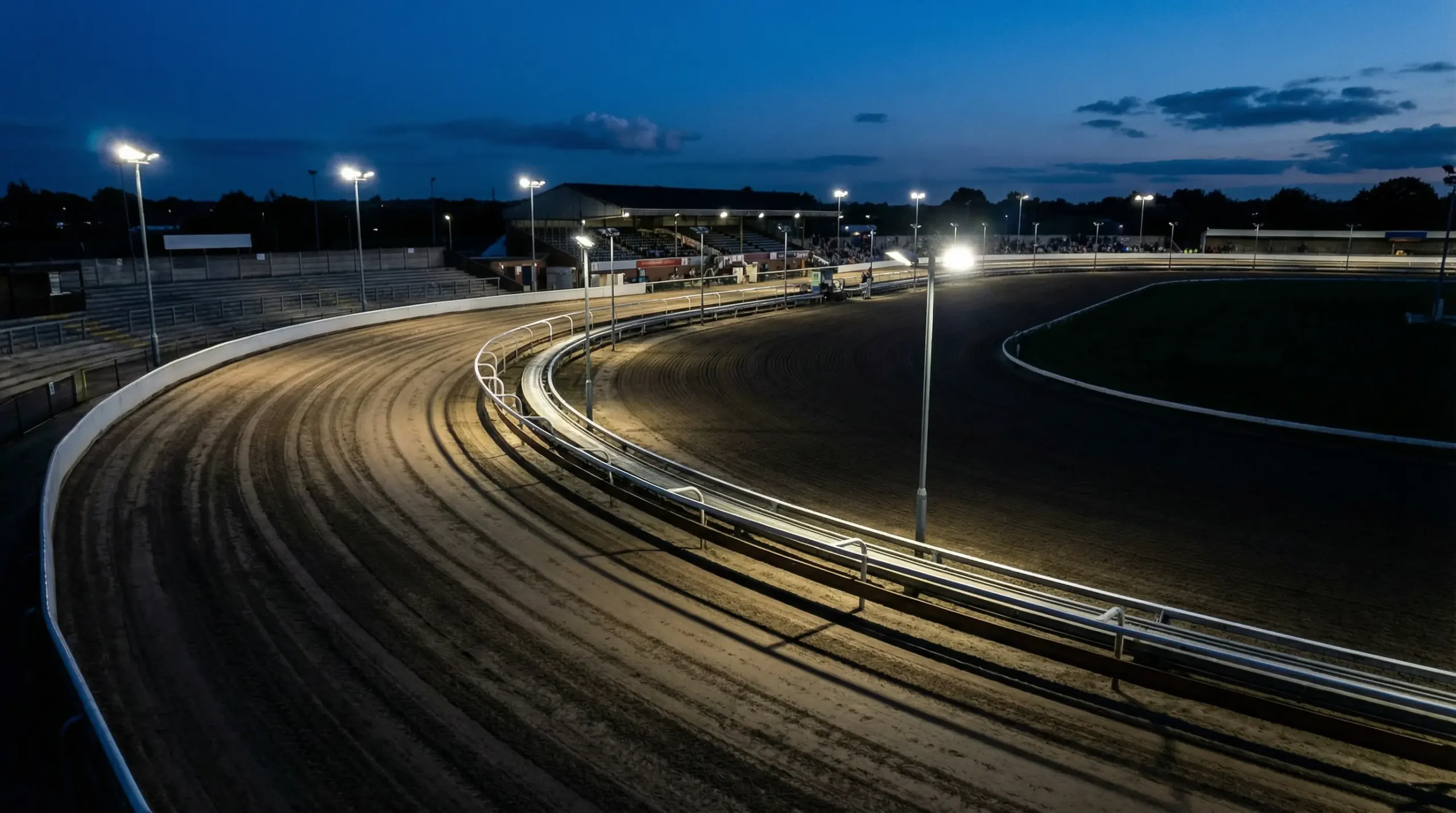
Not All Tracks Are Created Equal
Every UK greyhound track has a personality. The shape of the bends, the length of the straights, the distance from the traps to the first turn, the surface composition, the position of the hare rail — all of these physical characteristics combine to create an environment that favours certain types of dogs over others. This is track bias, and it is one of the most consistent edges available to greyhound bettors who study it.
Track bias is not a hidden phenomenon. It is a product of geometry and physics. A tight-turning track with a short run-up to the first bend structurally advantages inside-drawn dogs with quick early pace. A galloping track with sweeping bends and a long home straight gives wide runners and late finishers more room to operate. These are not tendencies that emerge from a handful of races and disappear. They are permanent characteristics of the track’s design, and they produce measurable statistical patterns across thousands of races.
The punter who studies track bias is not looking for a prediction system. They are looking for a correction — a way to adjust form analysis for the venue-specific factors that raw times and finishing positions do not capture. A dog that finished third at one track and third at another may have produced two entirely different performances depending on whether the tracks favoured or penalised its running style. Bias tells you which.
What Creates Track Bias
Track bias originates from the physical layout of the circuit. Three architectural features account for the majority of the bias at any venue: the run-up distance, the bend radius, and the home straight length.
The run-up is the distance from the starting traps to the first bend. Short run-ups — under forty metres — compress the field before the dogs have fully accelerated, which means the inside-drawn runners reach the bend before wide-drawn dogs can cross over. This creates a structural advantage for traps one and two that no amount of raw speed from trap six can consistently overcome. Long run-ups — fifty metres or more — allow the field to spread and give faster dogs time to establish position regardless of draw.
Bend radius affects how much ground a dog loses on the turn. Tight bends penalise wide runners more heavily because the extra distance around the outside of a sharp turn is proportionally greater. Wide, sweeping bends reduce this penalty, which is why galloping tracks produce more varied results by trap number than tight tracks. The inside advantage still exists on every track — it is a mathematical certainty on any curved course — but the magnitude varies considerably.
The home straight length determines how much room closers have to make up ground after the final bend. A short home straight means a dog that turns for home in second or third position has very little time to overhaul the leader. A long straight gives late runners the chance to sustain their finish and close the gap. Tracks with short straights produce a higher proportion of wire-to-wire winners, which reinforces the bias towards early pace and inside draws.
Surface condition interacts with these structural factors but does not override them. A wet surface slows all runners, but it does not change the geometry. A short run-up still favours inside draws when the sand is heavy. What changes is the magnitude of the times and the energy cost, not the directional bias.
Major UK Track Biases
Understanding the bias at the specific tracks you bet on is more valuable than understanding bias in the abstract. Each venue has its own profile, and the differences between them are significant enough to affect selection decisions.
Romford is the textbook example of a tight track with a pronounced inside bias. The run-up to the first bend is short, the bends are sharp, and the home straight is limited. Trap one wins at a rate well above the expected baseline, and trap six underperforms consistently. Dogs drawn wide at Romford must possess exceptional early pace just to compete with moderate railers, and the data shows that even exceptional pace from the outside is often not enough. Betting at Romford without accounting for the draw is betting blind.
Crayford, before its closure in January 2025, shared some of Romford’s characteristics — it was a relatively tight circuit with a short run-up — but the bend configuration was slightly different, producing a bias that still favoured inside draws but with less extreme suppression of the outside traps. The inside advantage at Crayford was real but more nuanced than at Romford, and dogs drawn in traps three and four performed better there relative to their Romford equivalents. The track’s closure removed one of the tighter circuits from the UK schedule.
Swindon, which closed in December 2025, presented a contrasting profile while it operated. The track was wider, the bends were more open, and the home straight provided more room for closing runs. The inside advantage still existed — it does at every track — but the gap between trap one and trap six win rates was narrower than at Romford or Crayford. Middle draws performed comparatively well at Swindon, and dogs with strong late pace had a better chance of converting from off the pace than at tighter venues.
Hove and Newcastle are among the more galloping tracks on the UK circuit. Longer run-ups and sweeping bends dilute the inside advantage and produce results that are more dependent on the quality of the dog than the number on the trap. Wide runners have a genuine chance at these venues, and the trap win rates across the six positions are closer to the theoretical baseline than at any tight circuit. Form reading at these tracks can rely more heavily on time and class and less on draw.
Monmore Green, Dunstall Park (which replaced Perry Barr after its August 2025 closure), Sheffield, Doncaster — each has its own bias profile shaped by its particular combination of run-up, bend tightness, and straight length. The biases are documented in the statistical databases maintained by Timeform, the Racing Post, and specialist greyhound data providers. Accessing and studying these numbers for the tracks you bet on regularly is one of the highest-return investments of time available to a greyhound bettor.
Trap Win Rates: Reading the Statistics
Trap win rates are the quantification of track bias. They measure the percentage of races won by each trap position over a defined sample period, and they are the most direct evidence of whether a track favours particular draws.
At a perfectly neutral track, each trap would win approximately 16.7 percent of races over a large enough sample. In reality, no track achieves this distribution. At a tight track like Romford, trap one might win twenty to twenty-two percent of races, while trap six wins twelve to fourteen percent. The differential — six to eight percentage points — represents a structural advantage worth between one-third and one-half of a standard win bet’s expected value.
Reading trap win rates requires context. A high win rate for trap one does not mean every dog drawn in trap one is a good bet. It means that, across all grades and race types at that track, trap one provides a positional advantage. Within any individual race, the quality of the dog, its running style, and its current form may override the bias. The statistics describe a long-term tendency, not a race-by-race certainty.
The most productive use of trap win rates is as a tiebreaker. When two dogs look evenly matched on form and you cannot confidently separate them, the one drawn in the statistically stronger trap has a quantifiable edge. Over a season of using trap bias to resolve close decisions, the cumulative advantage adds up. It is not dramatic in any single race. It is significant across a hundred.
Sample size matters. Trap statistics based on a year or more of racing at a track are reliable. Statistics from a single month are noisy. If you are using trap data, make sure the sample is large enough to smooth out short-term variance. Most published trap statistics from the major data providers use rolling twelve-month samples, which is a reasonable minimum.
Using Bias Without Overusing It
The risk with track bias is overreliance. Some punters discover trap statistics and begin betting exclusively on draw, backing trap one at tight tracks regardless of the dog’s form. This is bias taken to an extreme, and it does not work. The draw provides a positional advantage, not a performance guarantee. A slow dog in trap one is still a slow dog.
Bias is best used as a filter layered over form analysis. First, assess the dogs on their individual merits — times, splits, grade, weight, trainer form. Then check the draw. If your top-rated dog is also favourably drawn for the track, your confidence increases. If your top-rated dog is drawn in the weakest trap at a bias-heavy track, your confidence should decrease — not necessarily to the point of abandoning the selection, but enough to adjust your staking or consider an alternative.
The adjustment should be proportional to the strength of the bias. At Romford, where the inside advantage is extreme, draw should carry substantial weight in your decision. At Hove, where the bias is mild, it can carry less. Matching the intensity of your bias adjustment to the intensity of the track’s bias is the mark of a bettor who understands the concept rather than merely applying it.
Bias Is an Advantage Because Most Ignore It
Track bias is public information. The statistics are published, the patterns are documented, and any bettor with internet access can find the trap win rates for every UK track in five minutes. Despite this, the majority of the betting market does not fully incorporate bias into its pricing. Favourites at tight tracks are not consistently drawn inside. Long-priced runners in favourable draws are not consistently shortened to reflect their positional edge. The market misprices draw often enough to create opportunities for punters who treat bias as a core input rather than a curiosity.
The edge persists because it is boring. Track bias does not change from week to week. It does not produce dramatic stories or controversial selections. It sits quietly in the data, adding a small, consistent advantage to every bet placed with bias in mind. Over a season of racing, that small advantage compounds into something more substantial. The punters who profit from bias are not those who discovered it first. They are the ones who apply it every time, at every track, without exception or fatigue.
Analyse track bias at UK venues on the livegreyhoundtoday homepage.
Factor in trap draw alongside bias in trap draw.
